

Hot Keyword:
Author:Baby & Adult Diaper Materials FROM:Diaper Materials Manufacturer TIME:2026-11-26
Nonwoven fabrics are essential components in disposable hygiene products. They are widely used in baby diapers, sanitary napkins, adult incontinence products and disposable underpads because they can provide different combinations of softness, strength, liquid handling and barrier performance.
However, not all nonwoven fabrics have the same structure or function. Spunbond, SMS, spunlace and air through nonwovens are produced through different processes and are selected for different applications.
For hygiene product manufacturers, understanding these differences is important when choosing materials, developing product structures and improving production performance. This guide compares four common nonwoven types and explains what buyers should consider before purchasing them.
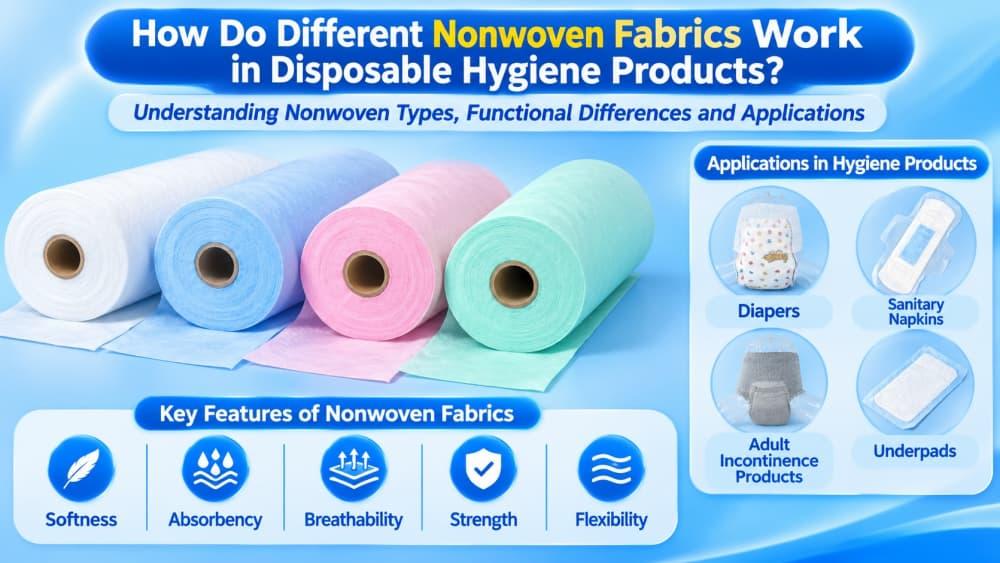
Nonwoven fabric is a sheet material made by bonding or interlocking fibers through mechanical, thermal or chemical processes rather than weaving or knitting yarns. The manufacturing method influences the fabric's structure, surface feel, strength, thickness and other properties.
In disposable hygiene products, nonwovens are used in different functional areas. Depending on the design, they may serve as a skin-contact layer, an outer cover, a barrier component or part of a liquid distribution structure.
Nonwoven fabrics offer manufacturers flexibility in material design. They can be produced with different fiber compositions, basis weights, widths, surface treatments and bonding characteristics.
For example, hydrophilic nonwoven can help liquid pass through a topsheet, while hydrophobic nonwoven can be used where liquid resistance is required. Softness and bulk may also be important when designing skin-contact layers.
A nonwoven fabric should be selected according to its intended position and function in the product. A material suitable for a diaper topsheet may not provide the barrier performance needed for a leg cuff. Similarly, a fabric designed for wipes may not be suitable for a high-speed diaper production line.
Spunbond nonwoven is produced by extruding polymer filaments, laying them into a web and bonding the filaments together. Polypropylene is commonly used in hygiene-related spunbond applications.
Spunbond materials are valued for their relatively good tensile strength, lightweight structure and production efficiency. With suitable hydrophilic or hydrophobic treatment, they can be used in different parts of disposable hygiene products.
Common characteristics include:
SMS stands for Spunbond-Meltblown-Spunbond. It combines two spunbond layers with a meltblown middle layer. This composite structure is designed to provide a combination of strength and barrier properties.
SMS materials are commonly associated with protective and barrier applications. Their suitability for a specific hygiene product depends on the required liquid resistance, softness, breathability and product construction.
Common characteristics include:
Spunlace nonwoven is produced by entangling fibers with high-pressure water jets. It can be made from different fiber blends, including viscose and polyester, depending on the intended application.
Spunlace is known for its soft hand feel and flexible structure. It is widely used in wet wipes and other applications where softness, absorbency and surface texture are important.
Common characteristics include:
Air through nonwoven, also called air-through bonded nonwoven, is commonly produced by bonding a fiber web with heated air. The process can create a soft, bulky and lofty material structure.
It is used in selected hygiene applications where softness, thickness and cushioning are important. Its performance depends on fiber type, web structure, bonding conditions and basis weight.
Common characteristics include:
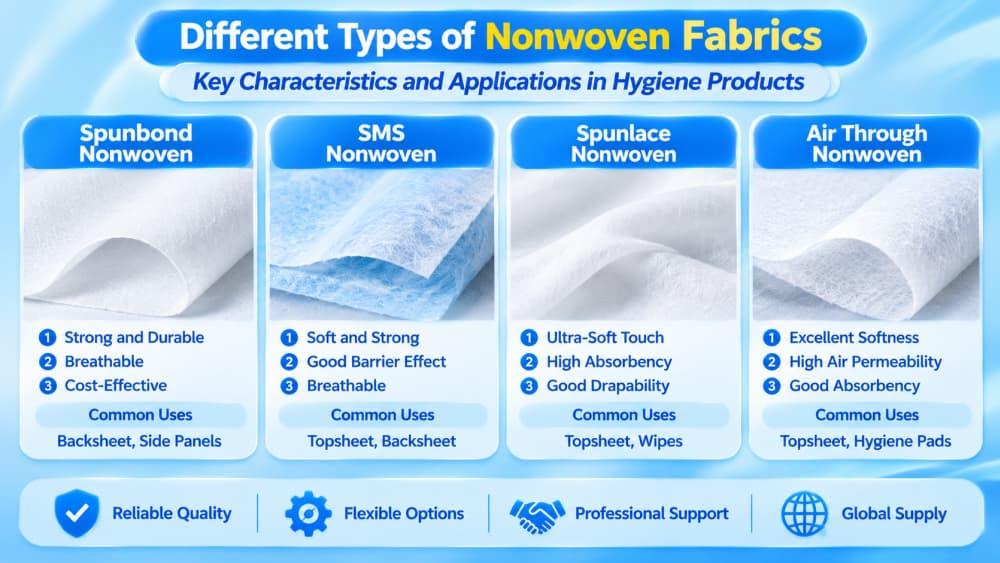
| Nonwoven Type | Main Characteristics | Typical Application Areas | Important Considerations |
|---|---|---|---|
| Spunbond | Lightweight, strength, versatile | Diaper components, side panels, outer covers | Wettability, strength, basis weight |
| SMS | Composite structure, barrier properties | Selected barrier and protective components | Barrier performance, softness, breathability |
| Spunlace | Soft, flexible, fiber-entangled structure | Wet wipes and selected hygiene applications | Fiber blend, absorbency, wet strength |
| Air Through | Soft, bulky, cushioning | Selected topsheet and acquisition-related applications | Bulk, softness, bonding and liquid handling |
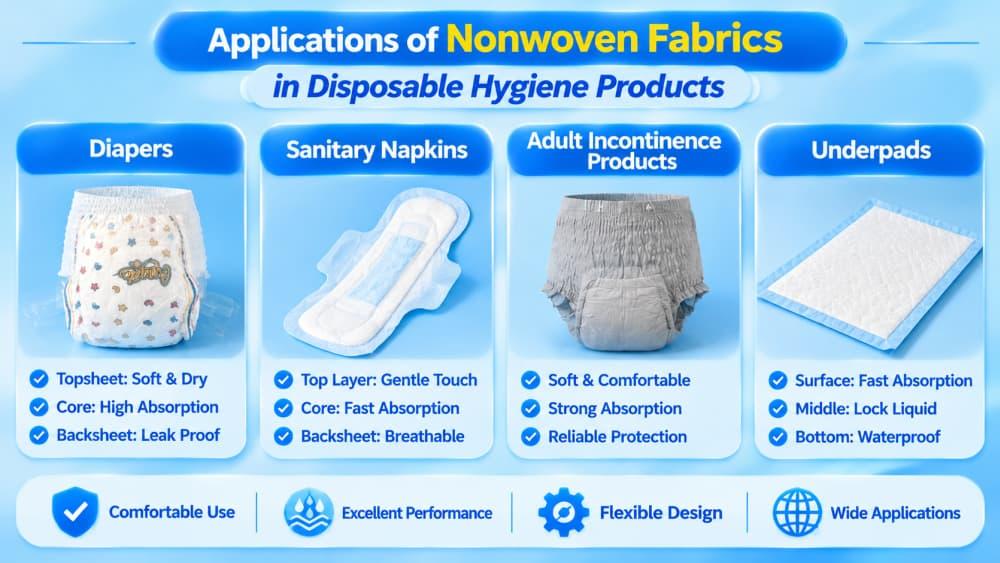
Nonwoven fabrics are used in several parts of baby diapers. Hydrophilic spunbond nonwoven is commonly used as a topsheet to allow liquid to pass into the absorbent structure. Hydrophobic nonwoven may be used in leg cuffs to help reduce leakage.
Nonwoven materials may also be used in outer covers, side panels and other components. The required specifications depend on the diaper design and the function of each part.
In sanitary napkins, nonwoven fabrics may be used as the topsheet or in other structural components. A topsheet needs to provide a comfortable surface while allowing menstrual fluid to pass into the absorbent core.
Material selection should consider softness, surface structure, liquid passage and compatibility with the absorbent layers.
Adult incontinence products include taped diapers and pull-up pants. Nonwoven fabrics are used in skin-contact layers, side panels, waist areas and other components according to the product construction.
For these applications, manufacturers may pay particular attention to softness, flexibility, strength and stable performance during production.
Disposable underpads generally use a multi-layer structure. Nonwoven fabric can provide the top surface, while the absorbent middle layer manages liquid and the bottom film helps prevent leakage.
The top layer should support liquid passage and user comfort. Its properties need to work together with the absorbent core and waterproof backing.
Before selecting a nonwoven fabric, manufacturers should identify where it will be used and what it needs to do. A topsheet, leg cuff and side panel have different functional requirements, even when they are used in the same diaper.
Hydrophilic treatment improves the ability of a material surface to be wetted by liquid. It is often required for topsheets and other liquid-receiving components.
Hydrophobic materials resist wetting and may be used in barrier-related components, such as leg cuffs. The required treatment should be confirmed according to the product design and test requirements.
Skin-contact components usually require a comfortable surface feel. Structural components may need sufficient tensile strength and dimensional stability to withstand converting and product assembly.
Manufacturers should evaluate these properties together rather than choosing a material based on softness or strength alone.
Even when a material meets laboratory specifications, it must also run reliably on the manufacturer's production line. Web tension, roll quality, width consistency, bonding behavior and feeding stability can all influence production performance.
| Product Component | Possible Nonwoven Choice | Key Requirement |
|---|---|---|
| Diaper Topsheet | Hydrophilic spunbond or selected air through nonwoven | Softness and liquid passage |
| Leg Cuffs | Hydrophobic spunbond | Liquid resistance and strength |
| Side Panels | Spunbond or suitable elastic composite | Flexibility and mechanical strength |
| Sanitary Napkin Topsheet | Suitable spunbond or other designed nonwoven | Softness and liquid handling |
| Wet Wipes | Spunlace | Softness, absorbency and wet strength |
| Selected Acquisition Layers | Air through or other suitable nonwoven | Bulk and liquid distribution |
GSM means grams per square meter and indicates the basis weight of the nonwoven fabric. It is one of the basic specifications buyers use when comparing materials.
Thickness is another important property, especially when softness, bulk or cushioning is required. However, GSM and thickness should not be treated as interchangeable measurements. Two materials with the same GSM may have different thicknesses and structures.
Material width should match the requirements of the converting equipment and product design. Incorrect width can lead to trimming waste or production difficulties.
Roll diameter and core size also matter because they influence machine loading, storage and material changeovers. Buyers should confirm these dimensions with the supplier before ordering.
Buyers should confirm whether the material needs to be hydrophilic or hydrophobic. For hydrophilic materials, liquid strike-through and wetting performance may need to be evaluated. For hydrophobic materials, water repellency and barrier-related performance may be more relevant.
Tensile strength affects how a nonwoven web performs during unwinding, feeding and converting. Consistency across the roll and between production batches is also important for stable manufacturing.
Buyers should check roll winding, edge condition, splice frequency, packaging protection and labeling. Proper packaging helps protect materials from contamination, moisture and damage during transportation and storage.
The lowest-priced material may not provide the performance or processing stability required by the product. Buyers should compare specifications, quality consistency and total production cost rather than focusing only on unit price.
Different components require different properties. A soft nonwoven is not automatically suitable for every skin-contact application, and a barrier-oriented material may not be appropriate for a liquid-receiving topsheet.
Material properties must match the production line. Buyers should evaluate unwinding, tension control, bonding and feeding performance during sample trials before approving a new material.
Incomplete purchase specifications can lead to misunderstandings between buyers and suppliers. A clear specification sheet should identify the material type, fiber or polymer composition where relevant, GSM, width, roll dimensions, treatment requirements and quality criteria.
Before placing a large order, manufacturers should request samples and conduct application-specific tests. A production trial can help confirm whether the material performs as expected under actual manufacturing conditions.
Spunbond, SMS, spunlace and air through nonwovens are commonly discussed material types. Their applications vary according to structure, performance and product requirements.
Spunbond is made from bonded continuous filaments. SMS combines spunbond layers with a meltblown middle layer, creating a composite structure with different barrier characteristics.
Spunlace is widely used in wipes because of its soft texture and fiber structure. Whether it is suitable for a diaper component depends on the required function, material specifications and product design.
Air through nonwoven is used in selected hygiene applications where softness, bulk and cushioning are important. Its suitability depends on the required liquid handling and product structure.
GSM means grams per square meter. It measures the basis weight of the fabric and helps buyers specify and compare material weights.
Buyers should evaluate product specifications, quality consistency, sample performance, production capacity, packaging standards and delivery reliability. Clear technical communication is also important.
Spunbond, SMS, spunlace and air through nonwovens each have different structures and performance characteristics. Their suitability depends on the function they need to perform in a disposable hygiene product.
For manufacturers, selecting the right nonwoven involves more than comparing material names or prices. GSM, width, surface treatment, strength, softness, roll quality and production compatibility all need to be considered.
By matching material properties with actual product requirements and conducting suitable sample and production trials, hygiene manufacturers can improve material utilization, product consistency and manufacturing efficiency.
A reliable raw material supplier can also support this process by providing clear specifications, consistent quality and materials suited to the manufacturer's application needs.

 MP/WhatsApp: +86-18050806553
 Manufacturer Address:Juhua Industry Matou Town, Nanan City Fujian Province China