

Hot Keyword:
Author:Baby & Adult Diaper Materials FROM:Diaper Materials Manufacturer TIME:2026-11-20
Choosing the right raw materials is essential for disposable hygiene product manufacturers. Materials that look similar or have comparable specifications may perform differently during product manufacturing and actual use.
To ensure consistent quality, manufacturers evaluate raw materials through a combination of laboratory testing, technical specifications and production line trials. These evaluations help determine whether a material meets product requirements, performs reliably and is suitable for existing manufacturing processes.
This guide explains the key performance indicators, common testing methods and practical evaluation procedures used in disposable hygiene manufacturing.
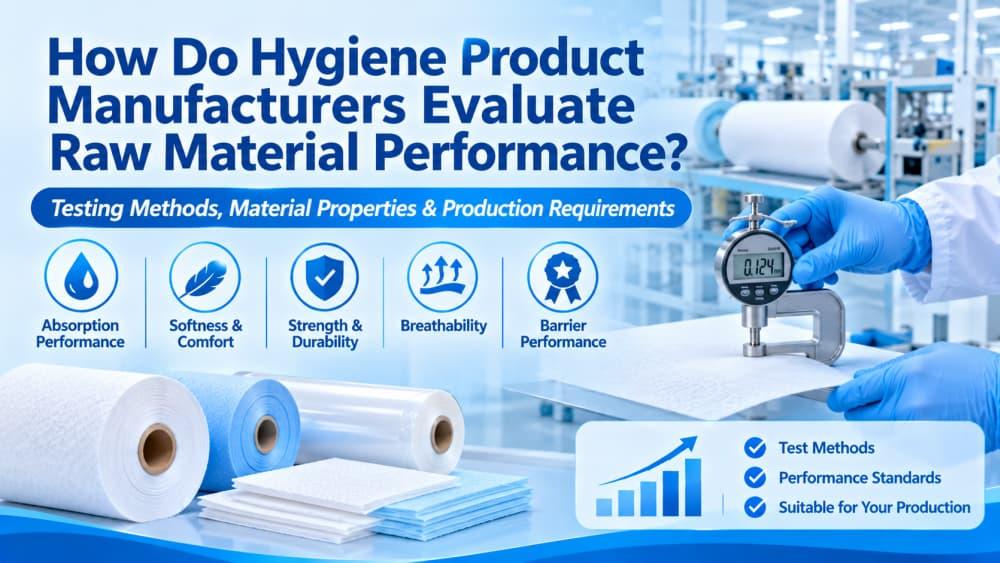
Raw material performance refers to how a material behaves under specific conditions and how effectively it fulfills its intended function in a disposable hygiene product. It includes physical properties, functional performance, processing characteristics and consistency.
Material evaluation helps manufacturers identify potential problems before materials enter mass production. It can reduce production interruptions, improve product consistency, minimize waste and ensure that finished hygiene products meet the intended quality requirements.
A material may meet its technical data sheet requirements but still perform differently on a production line. For example, a nonwoven fabric may meet its specified GSM and tensile strength while behaving differently during high-speed processing due to tension, roll quality or bonding characteristics.
For absorbent hygiene products, liquid handling performance is an important evaluation criterion. Manufacturers may examine absorption speed, liquid distribution, retention and rewet performance, depending on the material's function and position in the product structure.
These properties are particularly relevant when evaluating absorbent cores, SAP, ADL materials and other components involved in liquid management.
Softness and surface feel are important for materials that come into direct contact with the skin. Topsheet nonwoven fabrics and other contact layers may be evaluated for softness, surface texture, friction and overall comfort.
Material structure, fiber characteristics, bonding technology and finishing treatments can all influence the perceived softness of a material.
Strength and durability help determine whether a material can withstand handling, converting, stretching or other mechanical stresses during production and use.
Depending on the material, manufacturers may evaluate tensile strength, elongation, tear resistance, wet strength or other mechanical properties to ensure stable performance.
Breathability is an important property for certain hygiene product components, particularly materials used in areas where moisture and heat management are relevant.
Air permeability and water vapor transmission are different properties. Manufacturers may evaluate one or both depending on the material's function and the requirements of the final product.
Barrier performance is important for materials designed to prevent liquid leakage or provide protection. PE films, laminated materials and other barrier components may be evaluated for liquid resistance, integrity, leakage resistance and relevant mechanical properties.
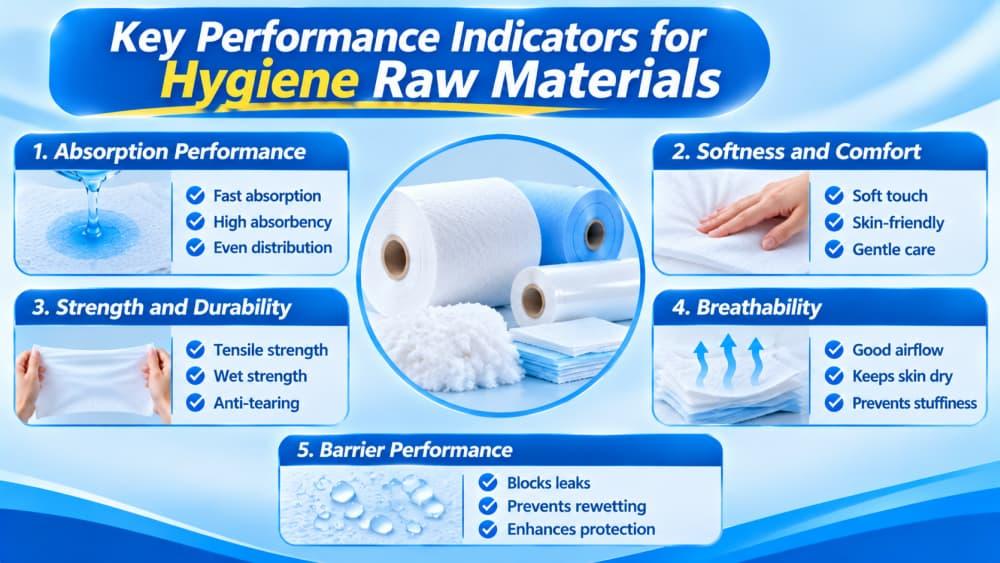
| Performance Indicator | What Manufacturers Evaluate | Typical Material Examples |
|---|---|---|
| Absorption | Absorption speed, liquid retention, distribution | SAP, ADL, fluff pulp |
| Softness | Surface feel, friction, softness consistency | Topsheet nonwoven |
| Strength | Tensile strength, elongation, tear resistance | Nonwoven, PE film, tapes |
| Breathability | Air permeability or water vapor transmission | Breathable film, nonwoven |
| Barrier Performance | Liquid resistance, leakage resistance, integrity | PE film, laminated materials |
Absorption tests are used to evaluate how materials interact with liquids. Depending on the material and its application, tests may measure absorption time, liquid capacity, liquid distribution, retention or rewet.
Testing conditions should be consistent so that results can be compared between samples, production batches or suppliers.
Tensile testing measures how a material responds to pulling forces. Manufacturers may evaluate maximum force, elongation and other mechanical properties to understand whether the material can withstand processing and application requirements.
Test direction, specimen dimensions and testing conditions should be controlled because they can influence the results.
Air permeability testing measures the amount of air passing through a material under specified conditions. It can help manufacturers evaluate breathable nonwoven fabrics and other materials where airflow is relevant.
Test results may be affected by material structure, thickness, density and test pressure, so standardized test conditions are important.
Barrier testing evaluates the ability of a material to resist the passage of liquids or other substances. Depending on the material, manufacturers may use leakage tests, hydrostatic pressure tests or other suitable methods.
These tests help determine whether barrier materials meet the performance requirements of their intended applications.
Softness may be evaluated using specialized instruments, surface friction measurements or controlled sensory assessments. Since softness is partly subjective, manufacturers may combine instrument-based measurements with standardized internal evaluation procedures.
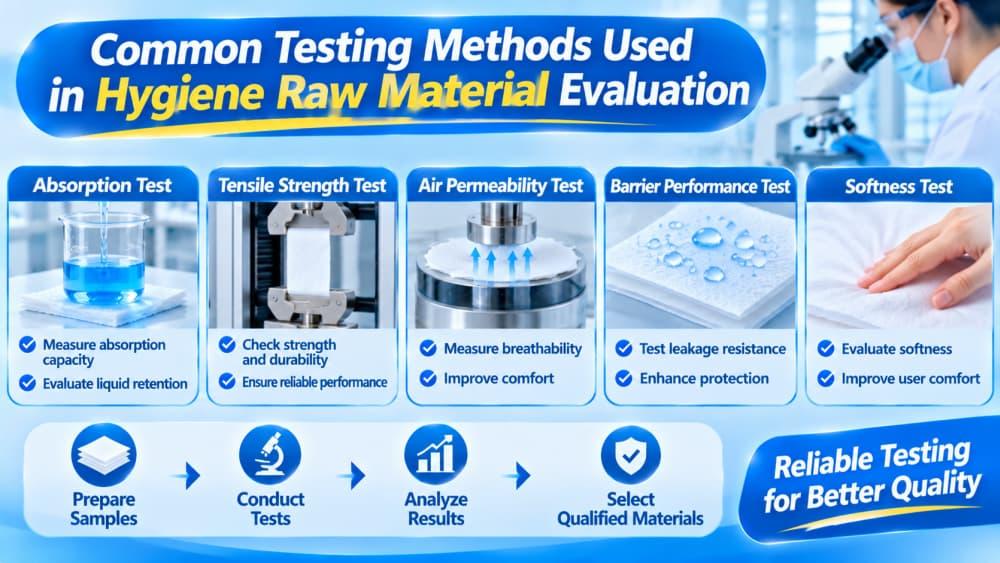
| Test Method | Purpose | Typical Evaluation |
|---|---|---|
| Absorption Test | Evaluate liquid handling | Absorption time, retention, rewet |
| Tensile Test | Evaluate mechanical strength | Force, elongation, breaking strength |
| Air Permeability Test | Evaluate airflow through materials | Airflow under specified pressure |
| Barrier Test | Evaluate liquid resistance | Leakage resistance, liquid penetration |
| Softness Test | Evaluate tactile properties | Surface feel, friction, softness measurements |
Laboratory testing provides controlled conditions for measuring material properties. It helps manufacturers compare materials, verify specifications and identify potential issues before production trials.
Laboratory testing is generally more controlled and repeatable, making it useful for quality control, supplier comparisons and incoming material inspection.
Production line trials evaluate how a material behaves under actual manufacturing conditions. A material may perform well in laboratory tests but still present problems when processed on a production line.
During line trials, manufacturers may observe machine compatibility, running speed, tension control, feeding stability, bonding performance, waste rate and production interruptions.
Laboratory testing and production line trials complement each other. Laboratory tests help verify measurable properties, while production trials provide practical information about processing behavior and production stability.
Using both approaches provides a more comprehensive basis for material approval.
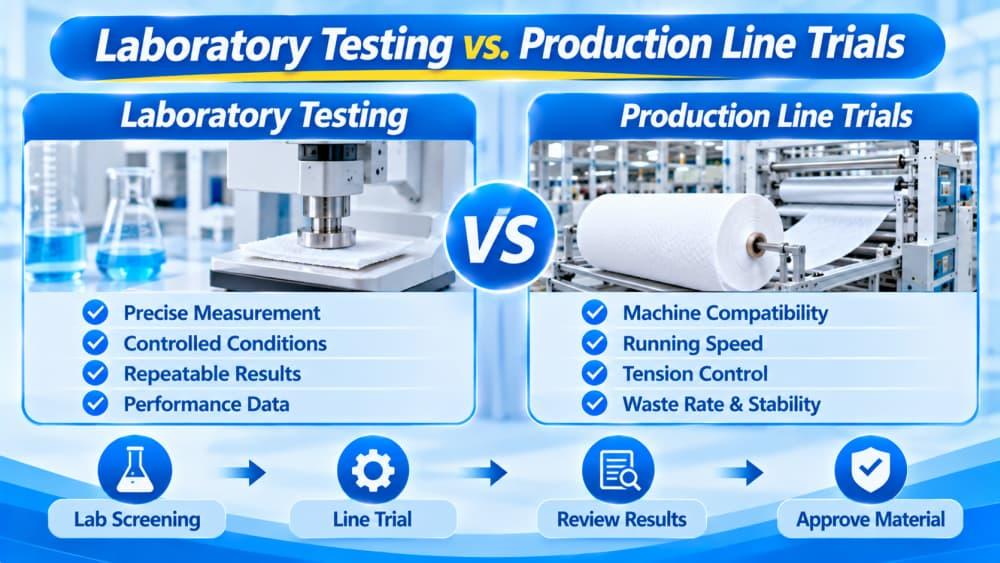
| Evaluation | Laboratory Testing | Production Line Trials |
|---|---|---|
| Testing Environment | Controlled conditions | Actual manufacturing conditions |
| Main Purpose | Measure material properties | Evaluate processing compatibility |
| Key Indicators | Strength, absorption, permeability and other properties | Running speed, feeding, tension, waste rate |
| Advantages | Repeatable and measurable results | Practical performance evaluation |
| Limitations | May not fully reflect actual production behavior | Results may be influenced by machine and production conditions |
| Role in Approval | Initial evaluation and verification | Final practical validation |
Materials with similar names and specifications may have different structures, fiber arrangements, bonding methods, formulations or manufacturing processes. These differences may influence performance even when basic specifications appear similar.
Production equipment, process control, raw material sources and manufacturing parameters can influence material consistency and performance. Different manufacturing technologies may also result in different functional characteristics.
Suppliers may use different inspection procedures, sampling frequencies, testing equipment and acceptance criteria. These differences can affect how materials are evaluated and how consistently specifications are maintained.
Buyers should not rely solely on supplier specifications or test reports. Independent evaluation under their own requirements and production conditions can help confirm whether materials are suitable for their manufacturing processes.
Manufacturers should define the technical and functional requirements for each material based on its intended use, product structure and production process. Requirements may include dimensions, GSM, strength, absorption, appearance and other relevant properties.
Standardized testing procedures help ensure that material evaluations are consistent. Testing methods, specimen preparation, conditioning, equipment and acceptance criteria should be clearly documented whenever possible.
Acceptance criteria define the acceptable ranges or minimum requirements for material properties. These criteria may be based on product specifications, internal quality standards, customer requirements and previous production experience.
Material approval should not rely on a single sample alone. Manufacturers may monitor incoming batches, compare test results and track performance over time to identify variations and maintain consistent quality.
| Step | Evaluation Activity | Purpose |
|---|---|---|
| 1 | Review technical specifications | Confirm basic material requirements |
| 2 | Conduct laboratory tests | Verify key performance indicators |
| 3 | Compare test results | Identify differences and potential risks |
| 4 | Conduct production line trials | Confirm processing compatibility |
| 5 | Review production performance | Evaluate stability, waste and product quality |
| 6 | Approve and monitor material | Maintain quality and batch consistency |
Testing helps manufacturers verify material properties, identify potential problems, reduce production risks and maintain consistent product quality.
Yes. Laboratory tests evaluate specific properties under controlled conditions, while production line trials assess real processing behavior. Machine compatibility, running speed, tension and other factors may affect actual performance.
Depending on the material, important indicators may include absorption, softness, tensile strength, elongation, air permeability, barrier performance, dimensions and consistency.
No. Testing methods should be selected according to the material's function, properties and intended application. Different materials require different evaluation methods.
Manufacturers should compare materials using consistent specifications, standardized testing conditions, comparable test results and production line trials whenever necessary.
Evaluation frequency depends on internal quality requirements, supplier performance, material risk, batch consistency and changes in production or specifications. Routine incoming inspections and periodic reviews are common approaches.
Evaluating hygiene raw material performance requires more than checking technical specifications. Manufacturers need to consider material properties, laboratory test results, production compatibility and consistency across batches.
By combining standardized testing with practical production line trials, manufacturers can make more informed material selection decisions, reduce production risks and improve product quality.
A systematic material evaluation process also helps manufacturers establish clearer acceptance standards and build a more reliable supply chain for disposable hygiene products.

 MP/WhatsApp: +86-18050806553
 Manufacturer Address:Juhua Industry Matou Town, Nanan City Fujian Province China