

Hot Keyword:
Author:Baby & Adult Diaper Materials FROM:Diaper Materials Manufacturer TIME:2026-11-10
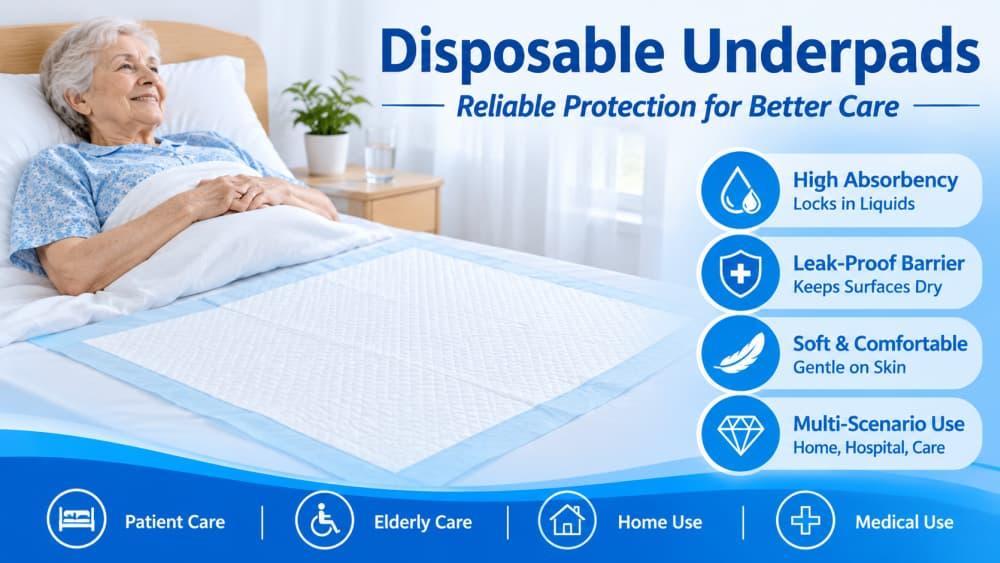
Disposable underpads are widely used in hospitals, nursing homes, home care, and other healthcare environments. They help protect beds, mattresses, chairs, and other surfaces from liquid contamination.
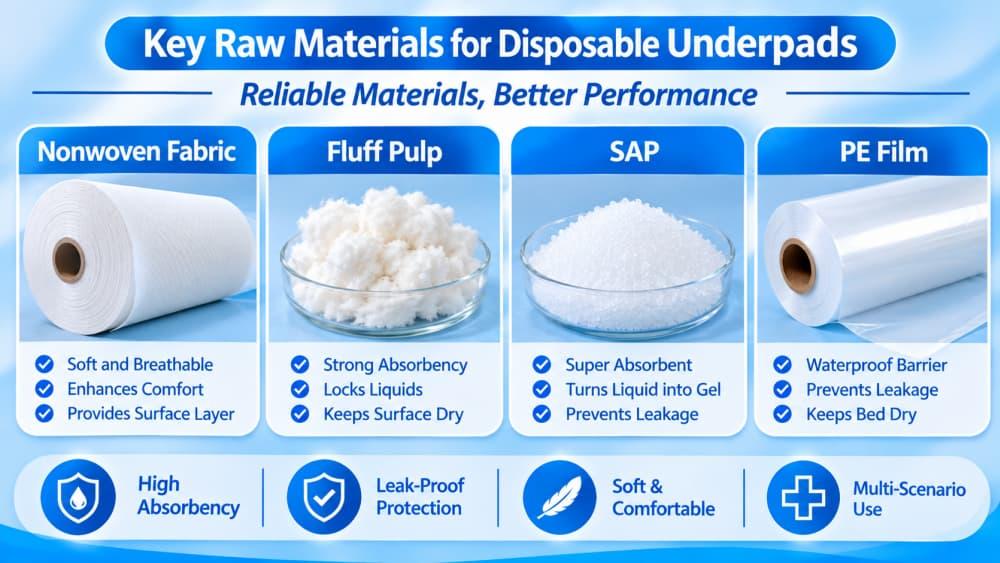
The performance of an underpad depends on the combination of different raw materials. Nonwoven fabric, fluff pulp, super absorbent polymer (SAP), and PE film are commonly used to provide surface comfort, liquid absorption, and leakage protection.
For underpad manufacturers and purchasing teams, understanding the function of each material is important when developing products, evaluating suppliers, and controlling production quality.
Disposable underpads are absorbent protective products designed to collect liquids and help keep the underlying surface dry. They are generally made with a soft surface layer, an absorbent section, and a waterproof backing layer.
Underpads are used in various care environments, including hospitals, nursing homes, home healthcare, baby care, and pet care. Different applications may require different levels of absorbency, product sizes, and material combinations.
Raw materials influence the underpad's absorption capacity, liquid retention, surface feel, leakage protection, and overall production cost. Choosing suitable materials helps manufacturers balance product performance and manufacturing requirements.
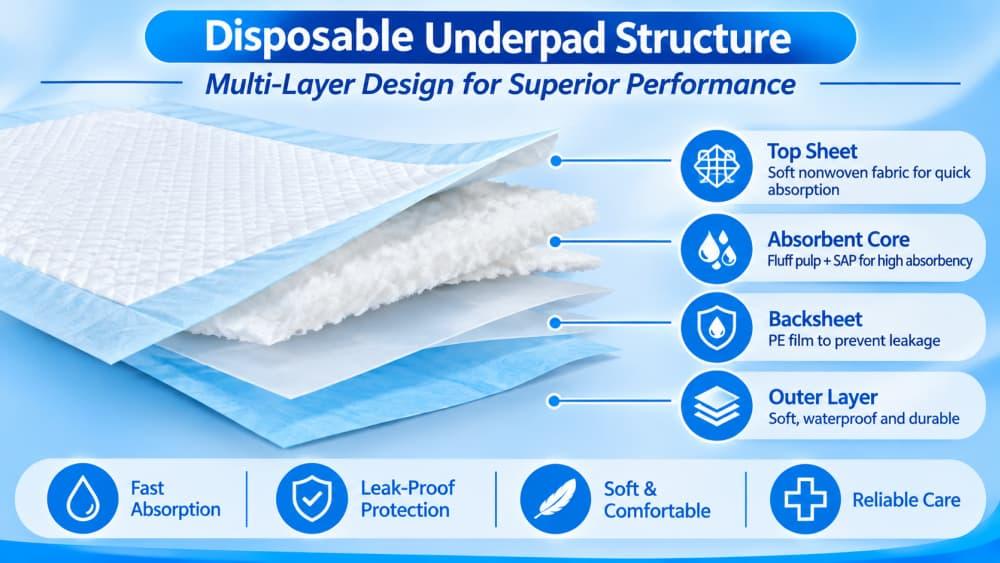
The top sheet is the surface that comes into contact with the user. Nonwoven fabric is commonly selected for this layer because it can provide a soft surface and allow liquid to pass into the absorbent core.
The absorbent core collects and retains liquid. It commonly uses fluff pulp, SAP, or a combination of absorbent materials. Some product designs also include tissue paper or other supporting materials to help maintain core structure.
The backsheet is designed to prevent liquid from passing through to the mattress or other protected surface. PE film is a common material for this layer because it provides a liquid-resistant barrier.
Depending on the product design, manufacturers may use additional materials such as tissue paper, hot melt adhesive, or other supporting layers. The exact construction varies according to product specifications and manufacturing processes.
Nonwoven fabric is commonly used as the top sheet of disposable underpads. It provides the surface that comes into contact with the user.
When selecting nonwoven fabric, manufacturers should consider softness, basis weight, tensile strength, surface uniformity, and liquid permeability. The appropriate specifications depend on the intended application and product design.
Fluff pulp is an important absorbent material. Its fibrous structure helps absorb and distribute liquid within the absorbent core.
Manufacturers should evaluate absorbency, fiber quality, cleanliness, and processing compatibility when selecting fluff pulp for underpad production.
SAP is used to absorb and retain liquid. It can absorb liquid and form a gel, helping improve the liquid retention capacity of the absorbent core.
Important selection factors include absorption capacity, absorption under pressure, particle size distribution, and gel stability. The required performance depends on the target product and its absorbent core design.
PE film is commonly used as the waterproof backsheet of disposable underpads. It helps prevent absorbed liquid from leaking onto the protected surface.
When selecting PE film, buyers should consider thickness, width, tensile properties, flexibility, appearance, and barrier performance. These specifications should match the product design and converting equipment.
Before choosing raw materials, manufacturers should identify the intended application, product size, target absorbency, surface requirements, and expected price range.
A hospital underpad, for example, may have different performance requirements from a basic home-care or pet-care pad.
Each material should be selected according to its function in the product structure. Nonwoven fabric should provide suitable surface properties, absorbent materials should meet liquid-handling requirements, and PE film should provide the required leakage protection.
Raw materials must also work with the manufacturer's production equipment. Roll width, unwinding performance, material strength, thickness, and other processing characteristics can affect production stability.
Using higher-cost materials does not automatically guarantee a better product. Manufacturers should evaluate the complete material combination and conduct product trials to determine whether the selected specifications meet the required performance at a reasonable cost.
Focusing only on purchase price may result in unsuitable material performance or production difficulties. Buyers should compare technical specifications, quality consistency, and processing compatibility as well as price.
Individual materials may perform well separately but may not work equally well when combined. For example, the absorbent core design and top sheet properties can influence liquid transfer and overall product performance.
Material specifications that do not match production equipment may cause unwinding problems, material breaks, unstable bonding, or unnecessary waste. Confirming processing requirements before ordering is important.
Testing new materials in actual production conditions helps manufacturers identify potential problems before large-scale purchasing. Trial results should be reviewed before approving a material for regular use.
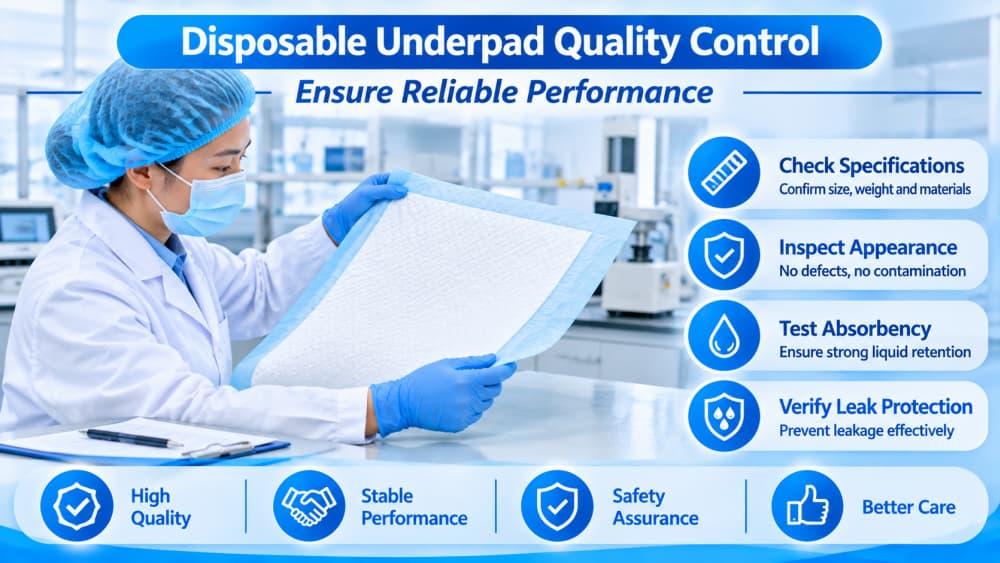
Review the material type, GSM, width, thickness, roll dimensions, and other relevant specifications. Confirm that the supplied material matches the approved technical requirements.
Check for visible contamination, damaged packaging, irregular rolls, and other defects. Proper packaging also helps protect materials during transportation and storage.
For the finished underpad, manufacturers can evaluate liquid absorption, retention, rewet, and leakage resistance according to their product requirements and test methods.
These finished-product tests should be distinguished from raw material inspection. Individual materials should also be checked using the relevant supplier specifications and material test methods.
Consistent material quality is important for stable production. Buyers should review batch records, inspection results, and supplier quality documentation to identify potential variations between deliveries.
Common materials include nonwoven fabric, fluff pulp, SAP, and PE film. Other supporting materials may be added depending on the product structure.
SAP absorbs and retains liquid by forming a gel. It is often combined with fluff pulp to improve the absorbent core's liquid-handling performance.
A liquid-resistant backing layer is commonly used to help prevent leakage. PE film is a widely used option, although the exact material and construction depend on the product design.
Manufacturers can review the combination of fluff pulp and SAP, the absorbent core structure, and the liquid transfer properties of the top sheet. Finished-product testing is necessary to evaluate the overall result.
Buyers should review technical specifications, product consistency, quality inspection procedures, packaging, production compatibility, and the supplier's ability to meet delivery requirements.
Disposable underpad performance depends on the right combination of raw materials. Nonwoven fabric provides the surface layer, fluff pulp and SAP contribute to liquid absorption and retention, and PE film helps prevent leakage.
For manufacturers and purchasing teams, successful material selection requires more than comparing prices. Understanding material functions, checking specifications, evaluating production compatibility, and conducting product trials can help achieve stable quality and efficient manufacturing.

 MP/WhatsApp: +86-18050806553
 Manufacturer Address:Juhua Industry Matou Town, Nanan City Fujian Province China