

Hot Keyword:
Author:Baby & Adult Diaper Materials FROM:Diaper Materials Manufacturer TIME:2026-11-03
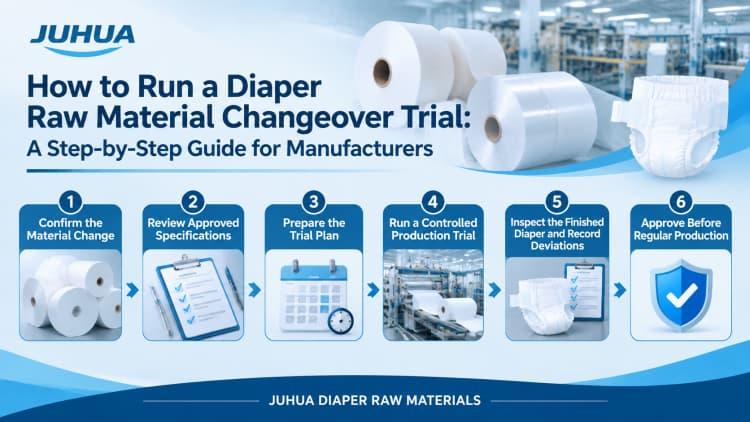
Short answer: A diaper raw material changeover trial should be planned and controlled before a new material is introduced into regular production. Manufacturers need to identify exactly what is changing, review the approved specifications, prepare a trial plan, control production conditions, inspect finished diapers, and document the results before approving the material for routine use.
A structured trial helps manufacturers identify compatibility issues, reduce unnecessary production disruption, and make material-change decisions based on recorded evidence rather than assumptions.
Diaper manufacturers may need to change raw materials for different reasons. A supplier may introduce a revised material, a purchasing team may qualify an alternative source, or the production team may need to evaluate a different material construction. Whatever the reason, a material change can affect more than the material itself. It may also influence feeding conditions, machine settings, product construction, finished-product quality, and production consistency.
For this reason, a raw material should not be treated as interchangeable simply because it appears similar to the material currently in use. A controlled changeover trial gives purchasing, quality, R&D, and production teams a practical way to evaluate the change before regular production begins.
A diaper is made from multiple materials that work together as a product structure. Depending on the diaper design, these may include topsheet nonwoven, ADL, absorbent core materials, backsheet film, elastic materials, fastening components, and construction adhesives.
Changing one material may influence how other components work together. For example, a different nonwoven may have a different surface feel or feeding behavior. A revised film may require the production team to check its compatibility with the existing converting process. An alternative absorbent material may need to be evaluated within the intended core construction.
A changeover trial helps the manufacturer:
The purpose is not simply to confirm that the new material can pass through the machine. The trial should evaluate whether it is suitable for the intended product and production conditions.
Not every purchasing adjustment requires the same level of evaluation. However, a controlled trial is appropriate when a proposed change could influence material quality, product construction, production behavior, or finished-diaper performance.
Common situations include:
The trial scope should reflect the actual change. A change involving a new supplier may require a different review from a minor packaging or identification change. The responsible teams should determine the necessary checks before production starts.
The first step is to define the material change clearly. A trial can become difficult to interpret if the team does not know exactly which material, specification, or supply source is being evaluated.
Record the following information before arranging the trial:
It is also important to distinguish between a supplier change and a specification change. If both are changed at the same time, the team may find it harder to determine which difference caused a particular result.
Where practical, keep the trial scope focused. Evaluate the proposed change against a clearly identified reference material and record any other production or product changes that could affect the comparison.
Before the trial, the relevant teams should review the current approved specification and the information available for the proposed material.
The review should focus on properties that matter to the material's actual function. The required checks depend on the material category and the manufacturer's product design.
| Material category | Points to review |
|---|---|
| Topsheet nonwoven | Material identification, agreed specifications, surface characteristics, and intended skin-contact application. |
| ADL material | Material construction, intended position in the absorbent structure, and relevant liquid-management requirements. |
| Absorbent core materials | Material grade, agreed specifications, compatibility with the core design, and handling requirements. |
| Backsheet film | Film type, agreed dimensions and specifications, intended barrier function, and converting compatibility. |
| Elastic materials | Material identification, agreed physical specifications, intended application, and process compatibility. |
| Adhesives | Product identification, application requirements, handling instructions, and compatibility with the relevant materials. |
Do not assume that two materials are equivalent based only on their product names or general descriptions. Compare the actual approved specifications and technical documents available for the materials.
If important information is missing or inconsistent, clarify it with the supplier before the trial. The production team should know which material is being tested and which requirements will be used for evaluation.
A trial plan helps different departments work toward the same objective. It also prevents the team from making production changes without recording what was done.
A practical trial plan should include:
The plan should also state how trial samples will be identified and separated from normal production output. Clear identification reduces the risk of mixing trial products with approved regular-production products.
One of the most important principles of a useful material trial is controlling variables. If the team changes several materials or production conditions at once, it may be difficult to identify the reason for a result.
Where possible, keep the existing product structure and production conditions consistent while evaluating the proposed material. If a machine adjustment is necessary, record what was changed, why it was changed, and when it occurred.
During the trial, record relevant information such as:
Do not rely on memory or informal comments after production. A written record makes the trial easier to review and compare.
A material may appear acceptable in a technical document but behave differently when it is introduced into an actual production process. The trial should therefore include observation of material handling and machine operation.
Depending on the material and production line, the team may monitor:
These observations should be interpreted in the context of the specific material and machine. A feeding issue does not automatically mean the material is unsuitable; it may also indicate that the production setup needs review. The team should investigate and document the cause instead of making an unsupported conclusion.
Successful material feeding is only one part of the evaluation. The finished diaper must also be checked against the product's applicable quality requirements.
Inspection items should be selected according to the material being changed and the product function that may be affected.
Depending on the trial scope, the team may review:
For example, a topsheet change may require attention to surface characteristics and the relevant liquid-handling requirements. A backsheet change may require checks related to the intended barrier function and material integrity. An absorbent core material change may require evaluation within the complete absorbent structure.
Use the manufacturer's approved inspection methods and acceptance criteria. Do not apply a generic pass/fail threshold to every material category.
Every unexpected observation should be recorded, even if the issue appears minor. A trial report should distinguish between confirmed defects, temporary production adjustments, and observations that still require investigation.
A useful deviation record includes:
For example, if a material shows unstable feeding, the team should record when the issue occurred and under what conditions. It should then review the material, machine setup, handling process, and other possible causes before deciding whether the material itself is responsible.
Documenting deviations prevents the team from overlooking problems simply because the trial was completed or production continued.
Once the trial and required inspections are complete, the responsible departments should review the results together.
The approval decision should consider the full evaluation rather than a single observation. Relevant questions include:
The result should be documented as an approval, conditional approval, or rejection according to the manufacturer's internal procedure.
If further evaluation is required, define the outstanding actions before the material is introduced into regular production. A completed trial does not automatically mean that the material has been approved.
Several avoidable mistakes can make a trial less reliable or create unnecessary production risks.
A disciplined process helps teams avoid these mistakes and makes the results more useful for future material qualification work.
Before closing a trial, the team can use the following checklist to confirm that the main steps have been completed.
| Stage | Confirmation item |
|---|---|
| Before the trial | Material change, supplier, specifications, product scope, and trial objective are identified. |
| Planning | Production arrangements, inspection requirements, sample identification, and responsibilities are defined. |
| During production | Material feeding, machine behavior, adjustments, interruptions, and deviations are recorded. |
| Product inspection | Finished samples are checked against the applicable product and material requirements. |
| Result review | Trial records, inspection results, and outstanding issues are reviewed by the responsible teams. |
| Final approval | The material receives documented approval before regular production use, according to internal procedures. |
A trial helps manufacturers evaluate whether a proposed material is suitable for the intended product and production process. It also provides an opportunity to identify feeding issues, product-quality differences, and other deviations before regular production.
The departments involved usually depend on the material and the manufacturer's internal process. Purchasing, production, quality, and R&D may all have relevant responsibilities. The trial plan should clearly define who conducts the evaluation and who approves the result.
No. A technical data sheet is an important part of the initial review, but it does not replace production evaluation and finished-product inspection. The material should be assessed against the applicable specifications and intended application.
Where practical, it is better to keep the trial scope focused. Changing several materials at the same time can make it difficult to identify the cause of a production or quality difference. If multiple changes are necessary, each change should be clearly documented and evaluated.
The report should include the trial objective, material identification, supplier and batch details, production conditions, inspection results, deviations, corrective actions, and the final review decision. The exact record format should follow the manufacturer's internal quality procedures.
Not automatically. The trial results should first be reviewed by the responsible departments, and the material should receive documented approval according to the manufacturer's internal procedures. Additional evaluation may be necessary if there are unresolved deviations or incomplete test results.
A successful diaper raw material changeover is not simply a matter of replacing one roll or material batch with another. It requires clear material identification, specification review, controlled production evaluation, finished-product inspection, and documented approval.
By following a structured trial process, diaper manufacturers can make more informed sourcing and production decisions while reducing the risk of introducing an unsuitable material into regular manufacturing.
For manufacturers evaluating diaper raw materials, JUHUA focuses on material supply for hygiene product applications. Clear specifications, effective communication, and appropriate material evaluation are important foundations for a reliable supplier relationship.

 MP/WhatsApp: +86-18050806553
 Manufacturer Address:Juhua Industry Matou Town, Nanan City Fujian Province China