

Hot Keyword:
Author:Baby & Adult Diaper Materials FROM:Diaper Materials Manufacturer TIME:2026-09-08
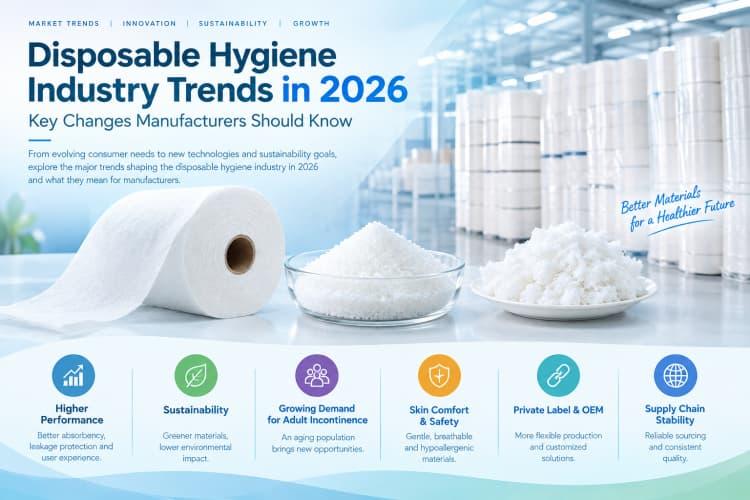
The disposable hygiene industry continues to evolve as consumer expectations, manufacturing technology, environmental concerns and market demand change.
Baby diapers, sanitary napkins, adult incontinence products and other absorbent hygiene products are no longer competing only on basic functionality. Consumers increasingly expect products to provide better absorbency, stronger leakage protection, improved comfort and a thinner overall design.
At the same time, manufacturers are facing new challenges. Material efficiency, sustainability, supply chain stability and production consistency are becoming increasingly important when developing new hygiene products.
The global disposable hygiene products market was estimated at approximately USD 251.7 billion in 2026, with the market projected to reach about USD 354.8 billion by 2033. Baby diapers remain the largest product segment, while adult diapers are expected to be one of the faster-growing segments.
For manufacturers and brands, understanding these changes is important not only for product development, but also for raw material selection and long-term sourcing strategies.
Disposable hygiene products were traditionally designed around a few fundamental requirements: absorb liquid, prevent leakage and provide basic comfort.
Today, these requirements are no longer enough.
Consumers increasingly expect hygiene products to be:
· thinner
· lighter
· more absorbent
· more comfortable
· more breathable
· more skin-friendly
· more reliable during extended wear
This change is particularly visible in baby diapers and adult incontinence products, where users may wear products for long periods.
For manufacturers, this means product development is becoming increasingly focused on performance optimization rather than simply adding more material.
As products become thinner and more sophisticated, every material has a more specific function.
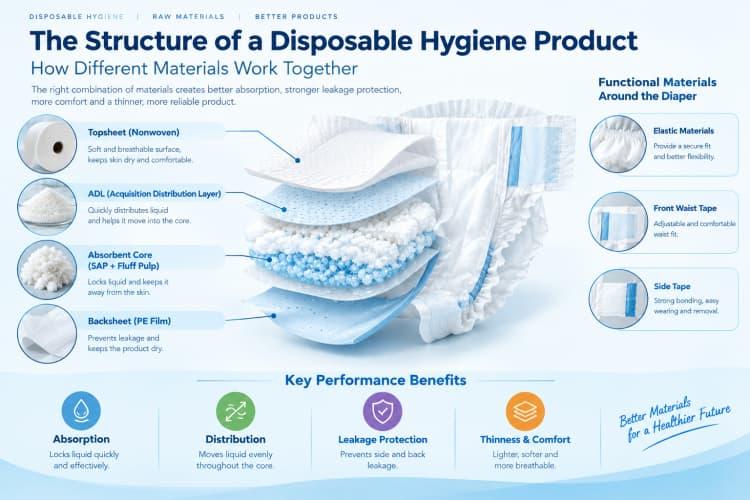
Nonwoven materials, superabsorbent polymer, fluff pulp, elastic components, PE film, acquisition and distribution layers, tapes and adhesives all need to work together as one system.
The objective is no longer simply to use more raw material.
Instead, manufacturers are looking for the right combination of materials to achieve the required performance while controlling product weight, cost and production efficiency.
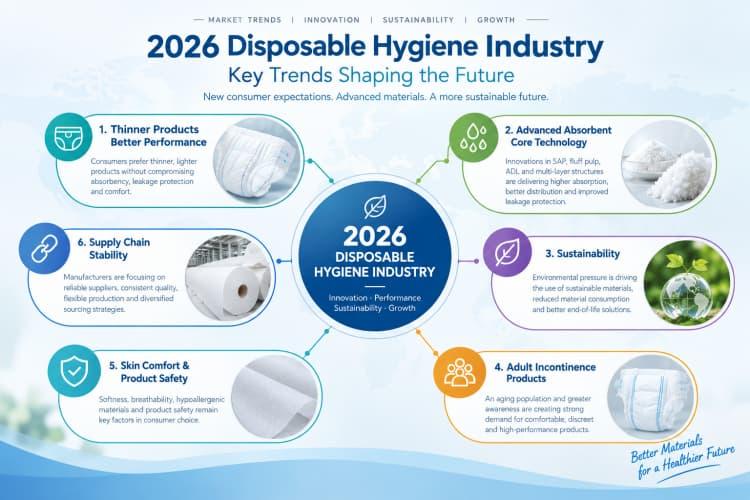
One of the most important trends in modern disposable hygiene products is the development of thinner products.
Consumers generally prefer products that feel less bulky while still providing reliable protection.
This creates a technical challenge for manufacturers.
A thinner diaper or sanitary product has less physical space available for its absorbent system. Therefore, the design of the absorbent core and the distribution of liquid become increasingly important.
Recent industry analysis also highlights advances in absorbent core design and multi-layer fluid distribution systems as important factors supporting thinner and lighter hygiene products.
Manufacturers are increasingly asking:
How can we achieve the same or better performance with less material?
This question affects almost every component of a disposable hygiene product.
For example, manufacturers may optimize:
· SAP distribution
· fluff pulp usage
· absorbent core structure
· ADL performance
· nonwoven basis weight
· elastic material consumption
· film thickness
· bonding systems
Better material efficiency can potentially reduce product weight and manufacturing costs while maintaining performance.
For diapers, sanitary napkins and adult incontinence products, absorption is one of the most important product functions.
However, absorption does not depend on SAP alone.
The overall absorbent system needs to manage liquid movement from acquisition to distribution and finally retention.
This makes the interaction between different layers and materials increasingly important.
SAP provides high liquid absorption and retention capacity, while fluff pulp contributes to liquid distribution and structure within traditional absorbent cores.
Manufacturers therefore need to consider the balance between the two materials rather than looking at absorption capacity in isolation.
A product with high SAP content does not automatically guarantee better real-world performance.
The final result depends on:
· liquid acquisition
· liquid distribution
· absorption speed
· retention
· rewet
· core stability
· leakage protection
Acquisition Distribution Layers can help receive liquid from the topsheet and distribute it across the absorbent structure.
This becomes particularly important when manufacturers try to develop thinner products.
If liquid cannot move efficiently through the structure, simply increasing absorbent material may not solve leakage or localized saturation problems.
Therefore, absorbent core design is becoming a system-level engineering problem rather than a single-material decision.
Sustainability is one of the most important changes affecting the disposable hygiene industry.
Absorbent hygiene products—including baby diapers, adult incontinence products and period products—contain complex combinations of plastics, fibers and absorbent materials.
A July 2026 study published in Nature Sustainability described absorbent hygiene products as a major source of plastic waste and emphasized that solving the problem requires coordinated changes involving materials, technology, consumer behavior, policy and economics.
This means sustainability is increasingly becoming a product-development issue rather than simply a marketing issue.
The industry is exploring different approaches, including:
· reducing material consumption
· using responsibly sourced materials
· developing alternative materials
· improving product recyclability
· developing compostable solutions
· improving waste-management systems
However, sustainability in hygiene products is technically challenging.
A material may be biodegradable under specific conditions but still fail to provide the required absorbency, strength, softness or leakage protection.
Therefore, manufacturers need to balance environmental objectives with product performance.
Researchers are also paying more attention to recycling used absorbent hygiene products.
The challenge is significant because these products combine multiple materials and are contaminated after use.
UCL researchers noted in 2026 that existing recycling technologies generally recover only part of the materials, while future systems will need better material separation and decontamination technologies.
For manufacturers, this suggests that future product design may increasingly consider what happens to the product after use, not just how it performs during use.
Adult incontinence is becoming increasingly important within the disposable hygiene industry.
Population aging, longer life expectancy and increasing awareness of incontinence care are supporting demand for disposable adult hygiene products.
According to Grand View Research, adult diapers are projected to record a 7.1% CAGR from 2026 to 2033, making the segment one of the faster-growing areas of the disposable hygiene market.
Adult users increasingly expect products that provide not only protection but also:
· comfort
· discretion
· thinness
· breathability
· odor control
· secure fit
· skin-friendly contact
This is changing how manufacturers approach adult incontinence product design.
Instead of focusing exclusively on maximum absorbency, manufacturers are increasingly considering the complete user experience.
The growth of adult incontinence creates opportunities for both established manufacturers and smaller brands.
New brands may enter the market through private label or OEM/ODM manufacturing, allowing them to develop products without building their own production facilities.
This can make flexible manufacturing and reliable raw material sourcing increasingly important.
Hygiene products remain in prolonged contact with the skin.
As a result, consumers are increasingly interested in:
· softness
· breathability
· fragrance-free options
· skin-friendly materials
· hypoallergenic positioning
· dermatological testing
Industry research also identifies skin friendliness and comfort as important factors influencing disposable hygiene product demand.
Regulatory and consumer attention toward product ingredients and materials is also increasing in some markets.
For manufacturers selling internationally, this means material documentation and product specifications may become more important during customer qualification.
Raw material suppliers may increasingly need to provide:
· technical data sheets
· material specifications
· quality documentation
· test results
· compliance information
· batch traceability
For B2B buyers, the supplier's documentation capability can become almost as important as the material itself.
The disposable hygiene market contains not only multinational manufacturers but also many regional and private-label brands.
These smaller brands may focus on:
· product positioning
· branding
· marketing
· distribution
· customer relationships
while outsourcing production to specialized manufacturers.
This creates opportunities for OEM and ODM manufacturers that can provide flexible production and customized product solutions.
Different markets require different product specifications.
For example, a buyer may request changes in:
· product size
· absorbency level
· GSM
· material combination
· elastic performance
· color
· printing
· packaging
· product construction
This means suppliers need to be able to support customization rather than simply offering one standard specification.
Smaller brands can also experiment with new product concepts more quickly than large organizations.
They may test:
· thinner diapers
· premium sanitary products
· skin-friendly products
· sustainable materials
· specialty adult incontinence products
· new absorbent structures
This creates an increasingly diverse market for hygiene raw materials.
Raw material price has always been important.
However, manufacturers are increasingly considering the risks associated with inconsistent supply.
A low-cost material is not necessarily economical if it causes:
· production interruptions
· inconsistent finished products
· excessive material waste
· machine problems
· delayed delivery
· quality complaints
Therefore, procurement teams are increasingly looking at total supply reliability, rather than purchase price alone.
For hygiene manufacturers, raw material consistency directly affects finished product consistency.
Changes in GSM, width, elasticity, tensile strength, absorbency or other characteristics can influence production performance.
This is why suppliers that can maintain stable specifications and provide reliable quality control have an advantage in long-term B2B relationships.
Another important consideration is supply-chain diversification.
Manufacturers may increasingly evaluate alternative suppliers or sourcing regions to reduce dependency on a single source.
For international hygiene brands, this can mean developing relationships with suppliers that can provide:
· stable production capacity
· consistent specifications
· reliable lead times
· export experience
· technical support
· flexible customization
The major trend across the industry is that individual materials are becoming less important than the performance of the complete product system.
For example, improving diaper absorbency may require coordination between:
Topsheet → ADL → Absorbent Core → SAP/Fluff Pulp → Backsheet
Similarly, leakage protection may depend on the interaction between absorbent materials, leg cuffs, elastic components, backsheet materials and product construction.
Manufacturers therefore need to evaluate materials based on their application rather than looking at each material independently.
As hygiene products become more technically advanced, the relationship between manufacturers and raw material suppliers is also changing.
A strong supplier should ideally provide:
· stable material quality
· clear specifications
· technical documentation
· consistent production
· flexible customization
· reliable delivery
· application knowledge
· responsive technical support
The supplier is becoming part of the product-development process rather than simply a source of raw materials.
One of the biggest challenges for the industry is finding materials that improve environmental performance without sacrificing essential product functions.
Manufacturers cannot simply replace an existing material with a “greener” alternative if the new material causes:
· leakage
· poor absorption
· skin discomfort
· reduced strength
· machine instability
· higher product failure rates
Future innovation will therefore depend on finding a better balance between performance, cost, material efficiency and environmental impact.
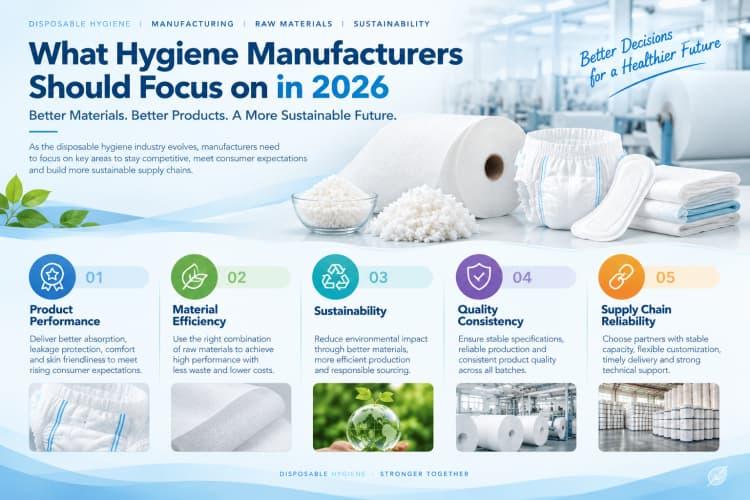
The disposable hygiene industry in 2026 is moving toward a more performance-driven, technology-oriented and sustainability-conscious future.
Several trends are particularly important:
· thinner and lighter products
· more efficient absorbent core designs
· stronger focus on leakage protection
· growing demand for adult incontinence products
· increasing attention to skin comfort and material safety
· greater sustainability pressure
· expanding private-label and OEM opportunities
· stronger requirements for supply-chain reliability
For hygiene manufacturers, these changes create both challenges and opportunities.
The companies that can combine product performance, efficient material selection, stable manufacturing and reliable sourcing will be better positioned to compete in the coming years.
At the same time, raw material suppliers have an increasingly important role to play. As product designs become more sophisticated, manufacturers need suppliers who understand not only the material itself, but also how that material performs within the finished hygiene product.
The future of disposable hygiene products will not be defined by a single material or technology. It will be shaped by how manufacturers combine materials, product design, manufacturing technology, consumer expectations and sustainability goals into better-performing products.

 MP/WhatsApp: +86-18050806553
 Manufacturer Address:Juhua Industry Matou Town, Nanan City Fujian Province China