

Hot Keyword:
Author:Baby & Adult Diaper Materials FROM:Diaper Materials Manufacturer TIME:2026-08-28
Liquid management is one of the most important factors affecting the performance of disposable hygiene products.
In products such as baby diapers, sanitary napkins, and adult incontinence products, liquid needs to move efficiently from the surface into the absorbent structure.
The Acquisition Distribution Layer (ADL) is a functional layer designed to support this process.
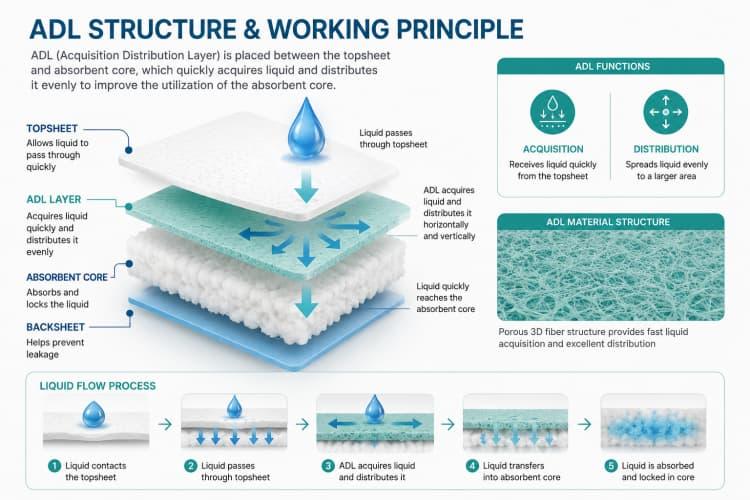
ADL is positioned between the topsheet and absorbent core in many absorbent hygiene products. Its main function is to help acquire liquid from the surface and spread it more evenly through the absorbent structure.
A suitable ADL material can help improve liquid transfer, distribution, and the utilization of the absorbent core.
For hygiene product manufacturers, however, choosing an ADL is not simply about selecting a material by GSM. Material structure, liquid-management performance, width, softness, permeability, and compatibility with the overall product construction should also be considered.
This guide explains the role of ADL, its material characteristics, major applications, and the key factors manufacturers should consider when selecting ADL materials.
ADL stands for Acquisition Distribution Layer.
It is a functional layer used in disposable absorbent hygiene products to help manage liquid between the topsheet and absorbent core.
The ADL receives liquid after it passes through the topsheet and helps distribute the liquid toward the absorbent core.
Its basic function can be summarized as:
Acquire → Distribute → Transfer
Acquisition refers to the ability of the ADL to receive liquid efficiently after it passes through the topsheet.
Fast acquisition can help move liquid away from the surface and into the internal absorbent structure.
This function is particularly important when the product needs to handle liquid within a short period.
Distribution refers to the ability of the ADL to spread liquid through the absorbent structure.
Instead of allowing liquid to remain concentrated in one small area, the ADL helps distribute it more evenly.
This can support more effective utilization of the absorbent core.
A typical absorbent structure can be simplified as:
Topsheet
↓
ADL
↓
Absorbent Core
↓
Backsheet
Each layer performs a different function, and the ADL acts as an important transition layer between the topsheet and absorbent core.
One important function of ADL is to support the movement of liquid away from the surface.
If liquid remains near the surface for too long, it may negatively affect the overall product performance.
An effective ADL provides a pathway for liquid to move into the absorbent structure.
Liquid may initially enter the product in a concentrated area.
ADL helps spread liquid through the absorbent structure rather than allowing it to remain concentrated in one location.
This can help increase the effective utilization of the absorbent area.
By helping liquid move into the internal structure, ADL can contribute to improved surface dryness.
However, surface dryness is affected by the complete product structure.
The topsheet, ADL, absorbent core, liquid volume, pressure, and other factors can all influence the final result.
The absorbent core contains the main absorbent materials responsible for liquid retention.
If liquid remains concentrated in one area, some parts of the absorbent structure may not be used effectively.
By helping distribute liquid, ADL can support more efficient use of the absorbent core.
The process begins when liquid reaches the topsheet.
The topsheet is designed to allow liquid to pass into the internal structure while maintaining the desired surface properties.
After passing through the topsheet, liquid enters the ADL.
The structure of the ADL allows liquid to move through the material.
The acquisition performance depends on the material structure and the overall product design.
After acquisition, liquid moves through the ADL structure.
The ADL helps spread liquid across the absorbent structure.
Depending on the product design, both vertical and horizontal liquid movement may contribute to the overall distribution process.
After passing through the ADL, liquid moves toward the absorbent core.
The absorbent core then performs the primary absorption and retention functions.
The overall pathway can therefore be described as:
Liquid → Topsheet → ADL → Absorbent Core → Liquid Retention
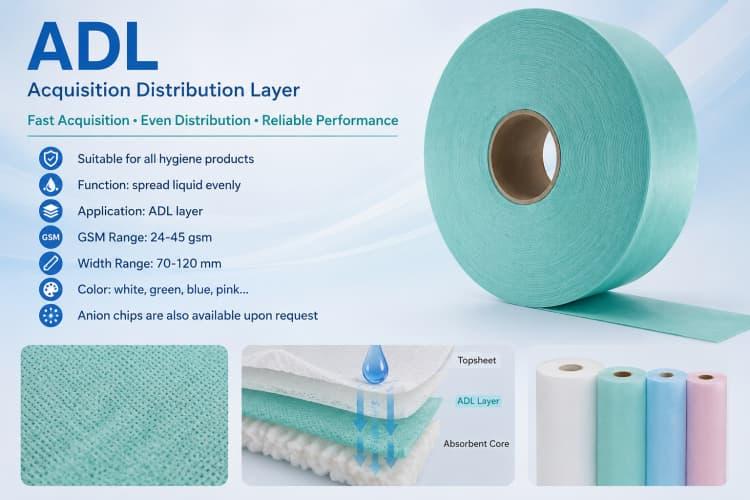
The ADL material is designed for use in the ADL layer of disposable hygiene products.
According to the product specifications, it is suitable for all hygiene products.
This makes the material applicable to different disposable absorbent hygiene product structures.
The main function of the material is to spread liquid evenly.
This supports the distribution stage of the absorbent system and helps move liquid through the internal structure.
The available GSM range is:
24–45 gsm
GSM can affect the material structure, thickness, handling, and overall performance.
The appropriate specification should be selected according to the customer's product design and production requirements.
The available width range is:
70–120 mm
Width should be selected according to the customer's product construction and converting requirements.
Available colors include:
· White
· Green
· Blue
· Pink
· Other colors according to requirements
Color selection can be discussed according to the customer's product specifications.
Anion chips are also available upon request.
Customers requiring this option can discuss the specific requirements when requesting samples or quotations.
An ADL should be able to receive liquid efficiently after it passes through the topsheet.
Good acquisition performance helps reduce the amount of liquid remaining close to the surface.
Liquid distribution is one of the main functions of ADL.
The material should help spread liquid through the absorbent structure rather than allowing it to remain concentrated in a single area.
Permeability affects how easily liquid can pass through the material.
The internal structure needs to provide suitable pathways for liquid movement.
Thickness and internal structure can affect liquid-management behavior.
However, thicker material does not automatically mean better performance.
The material should be selected according to the complete product structure and required performance.
Softness can be an important consideration in disposable hygiene products.
The appropriate material characteristics depend on the position of the ADL and the construction of the final product.
The ADL should maintain its structure during manufacturing processes such as:
· Material feeding
· Lamination
· Cutting
· High-speed converting
· Product assembly
Stable material performance helps reduce production variation.
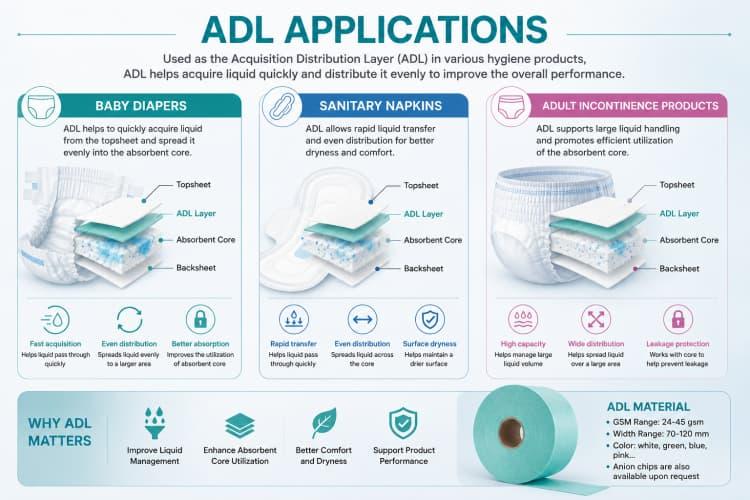
ADL can be used as part of the absorbent structure of baby diapers.
Its main function is to acquire liquid from the topsheet and distribute it toward the absorbent core.
The required material specification depends on the diaper structure, absorbent core, topsheet, and manufacturing process.
ADL can also be used in sanitary napkins.
It helps manage liquid after it passes through the topsheet and supports transfer toward the absorbent structure.
The ideal specification may vary depending on the product construction and performance requirements.
Adult incontinence products may need to manage larger liquid volumes.
ADL can support liquid acquisition and distribution within the absorbent structure.
The selected material should match the product's absorbent system and production requirements.
Because the material is designed to be suitable for hygiene products, ADL can also be considered for other disposable absorbent product structures.
The final specification should always be confirmed according to the specific application.
The main role of ADL is:
Acquire → Distribute → Transfer
It primarily supports liquid movement through the absorbent structure.
The absorbent core primarily performs:
Absorb → Retain
It contains the main absorbent materials responsible for absorbing and retaining liquid.
ADL and the absorbent core perform different but complementary functions.
If the ADL transfers liquid effectively but the absorbent core cannot receive and retain it efficiently, the overall liquid-management performance may still be limited.
Therefore, ADL should be evaluated as part of the complete absorbent system.
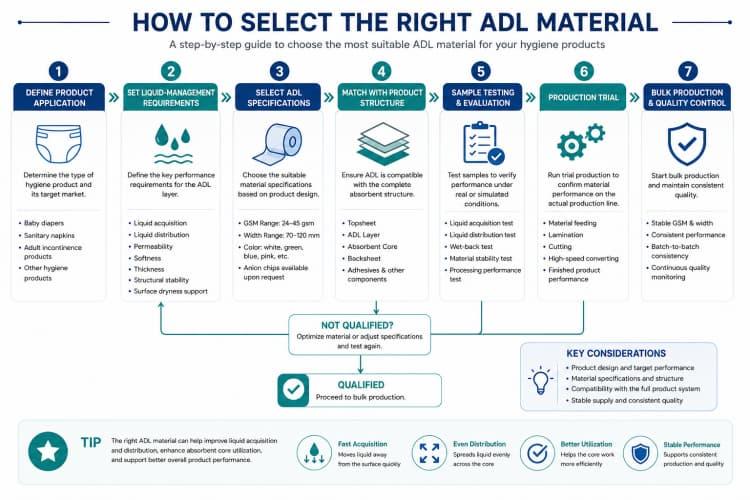
First identify where the ADL will be used.
For example:
· Baby diapers
· Sanitary napkins
· Adult incontinence products
· Other disposable absorbent products
The buyer should determine the required:
· GSM
· Width
· Material structure
· Liquid acquisition
· Liquid distribution
· Softness
· Structural stability
For this product, the available GSM range is 24–45 gsm, while the available width range is 70–120 mm.
The ADL should be considered together with other layers, including:
· Topsheet
· Absorbent core
· SAP
· Fluff pulp
· Adhesive
· Backsheet
The objective is to create a compatible liquid-management system.
Before placing a bulk order, manufacturers should test samples under actual or simulated production conditions.
Testing can help evaluate:
· Liquid acquisition
· Liquid distribution
· Wet-back behavior
· Material stability
· Processing performance
After the material meets the technical requirements, buyers should also evaluate consistency between production batches.
Stable GSM, width, material structure, and overall quality are important for high-speed hygiene production.
If liquid enters the ADL too slowly, more liquid may remain near the surface.
Possible factors include material structure, permeability, thickness, and compatibility with the topsheet.
If the ADL does not distribute liquid effectively, liquid may remain concentrated in one area.
This can limit the effective utilization of the absorbent structure.
Wet-back refers to liquid returning toward the surface after entering the absorbent structure.
ADL performance can influence wet-back, but it is not the only factor.
The topsheet, absorbent core, pressure, liquid volume, and overall product construction can also affect wet-back.
If the ADL does not maintain sufficient structural stability, it may deform during converting or assembly.
This can affect the consistency of the absorbent structure.
Variations in GSM, width, thickness, or material structure can lead to differences in production performance.
Consistent raw material quality is therefore important for disposable hygiene manufacturers.
The Acquisition Distribution Layer is an important functional component in disposable hygiene products.
Its main function is to acquire liquid and spread it evenly through the absorbent structure before it reaches the absorbent core.
ADL can be used in:
· Baby diapers
· Sanitary napkins
· Adult incontinence products
· Other disposable hygiene products
The ADL material covered in this guide offers:
· GSM Range: 24–45 gsm
· Width Range: 70–120 mm
· Colors: White, green, blue, pink, and others
· Application: ADL layer
· Function: Spread liquid evenly
· Anion chips: Available upon request
Choosing the right ADL requires more than comparing GSM or price.
Manufacturers should consider liquid acquisition, liquid distribution, material structure, width, softness, structural stability, and compatibility with the complete absorbent system.
The right ADL material can help create a more efficient liquid-management pathway and support stable performance in disposable hygiene products.
 MP/WhatsApp: +86-18050806553
 Manufacturer Address:Juhua Industry Matou Town, Nanan City Fujian Province China