

Hot Keyword:
Author:Baby & Adult Diaper Materials FROM:Diaper Materials Manufacturer TIME:2026-08-26
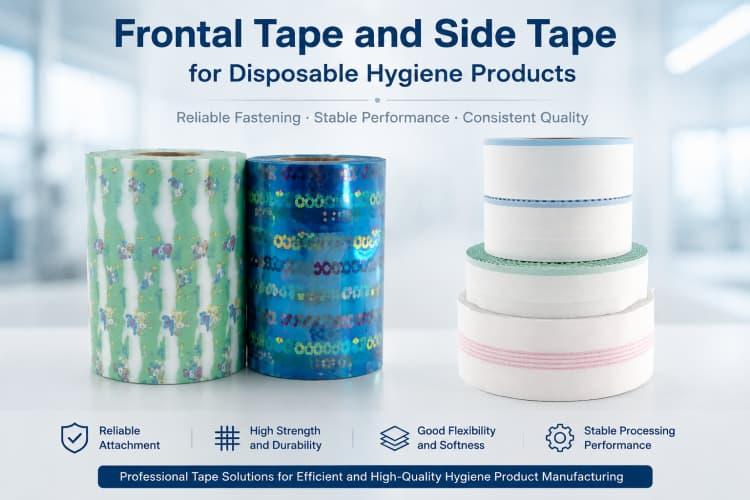
Frontal tape and side tape are functional materials used in disposable hygiene product manufacturing.
They are designed to work as part of the fastening structure and need to provide reliable attachment, suitable flexibility, and stable performance during production.
For manufacturers, selecting the right tape is not simply a matter of choosing a material with strong adhesion. Surface compatibility, peel performance, tensile strength, flexibility, dimensions, and production conditions should all be considered.
This guide explains the role of frontal tape and side tape, their material structure, important performance properties, and the main factors buyers should evaluate when selecting a supplier.
Frontal tape and side tape are fastening-related materials used in disposable hygiene manufacturing.
They are incorporated into the product structure to create a functional fastening system.
Frontal tape is positioned on the front area of the fastening structure.
Its surface is designed to provide a suitable area for the corresponding fastening component to attach and detach during use.
The tape needs to maintain stable surface properties while also remaining flexible enough for the overall material structure.
Side tape is used as part of the fastening structure on the side area.
It connects with other components of the fastening system and needs to provide reliable mechanical performance during production and use.
Even though tape is a relatively small component compared with some other raw materials, inconsistent tape quality can affect the overall fastening system.
Important factors include:
· Surface consistency
· Adhesion performance
· Peel performance
· Tensile strength
· Flexibility
· Width consistency
· Dimensional stability
Although frontal tape and side tape are both related to fastening, their functions and material requirements are not always identical.
The main role of frontal tape is to provide a suitable fastening surface.
Its surface characteristics are therefore particularly important.
Important considerations include:
· Surface uniformity
· Attachment performance
· Peel characteristics
· Width
· Flexibility
· Durability
Side tape forms another part of the fastening structure.
It may need to withstand mechanical tension during production and use.
Important considerations include:
· Tensile strength
· Flexibility
· Width
· Attachment performance
· Dimensional stability
· Processing compatibility
Using the same material specification for every tape application may not always provide the best result.
The appropriate material should be selected according to the actual fastening structure and production process.
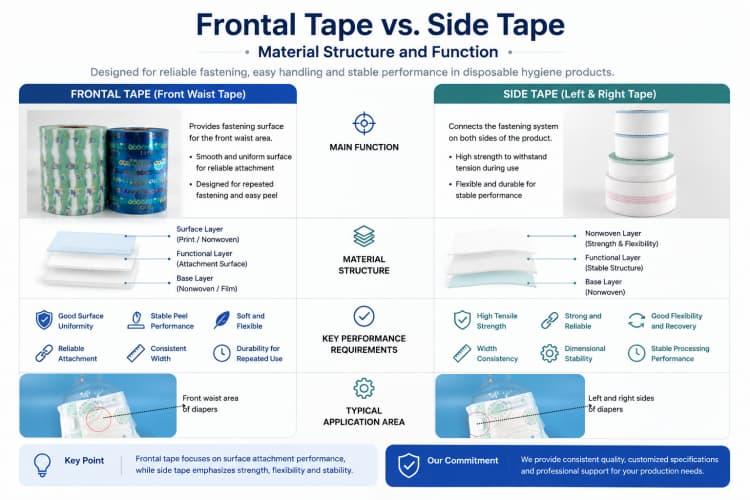
Frontal and side tapes can be produced using different material structures depending on the required performance and manufacturing process.
Nonwoven materials can be used as a base or surface structure for fastening-related materials.
They can provide:
· Softness
· Flexibility
· Lightweight construction
· Suitable surface characteristics
The specific nonwoven structure should be selected according to the required fastening performance.
Polypropylene is commonly used in disposable hygiene material structures because of its lightweight characteristics and processability.
Depending on the product construction, polypropylene-based materials can be engineered for suitable strength, flexibility, and surface properties.
Some fastening materials can use multiple material layers to achieve a balance between different properties.
For example, a composite structure may be designed to combine:
· Surface performance
· Mechanical strength
· Flexibility
· Processing stability
The final material construction should be selected according to the customer's production requirements.
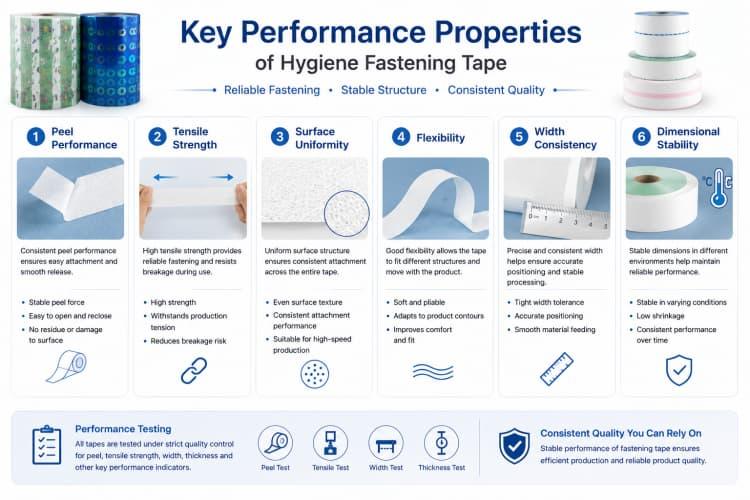
When evaluating frontal tape and side tape, buyers should consider several technical properties.
Peel performance describes how the fastening material behaves when the two surfaces are separated.
Stable peel performance is important for consistent fastening behavior.
The target peel characteristics depend on the fastening system and application.
The tape needs sufficient tensile strength to withstand tension during production and use.
Low tensile strength can increase the risk of stretching, deformation, or breakage.
For materials that provide a fastening surface, surface consistency is critical.
Variation in surface structure can lead to inconsistent attachment performance.
The tape should be flexible enough to integrate into the overall product structure.
Excessively stiff material may affect processing or the behavior of the finished structure.
Tape is normally processed at high speed.
Consistent width helps maintain stable positioning and material feeding.
The material should maintain stable dimensions during storage and processing.
Changes in width or structure can affect downstream production.
Frontal tape and side tape do not work independently.
They are part of a larger material system.
The tape may need to be combined with or positioned alongside nonwoven materials.
Compatibility between the two materials can affect:
· Lamination
· Adhesion
· Processing
· Surface appearance
Hot melt adhesive may be used to bond different material layers in disposable hygiene manufacturing.
The adhesive needs to be compatible with the tape surface and the surrounding material structure.
For this reason, buyers should evaluate the tape and adhesive system together rather than testing each material in isolation.
Depending on the product construction, the fastening material may also need to work with other nonwoven, film, or elastic components.
A complete production trial is therefore recommended before large-scale purchasing.
Material selection should begin with the customer's production requirements.
First determine:
· Frontal tape
· Side tape
· Fastening surface
· Other fastening-related applications
Different applications may require different material specifications.
Important dimensions may include:
· Width
· Roll length
· Thickness
· Core size
· Roll diameter
Stable dimensions are important for automated production.
Buyers should compare:
· Tensile strength
· Peel performance
· Flexibility
· Dimensional stability
· Surface consistency
The correct balance depends on the specific application.
Laboratory testing alone may not provide a complete picture.
Samples should be tested using the customer's actual:
· Production equipment
· Adhesive
· Nonwoven
· Fastening components
· Processing speed
This can help identify compatibility problems before bulk production.
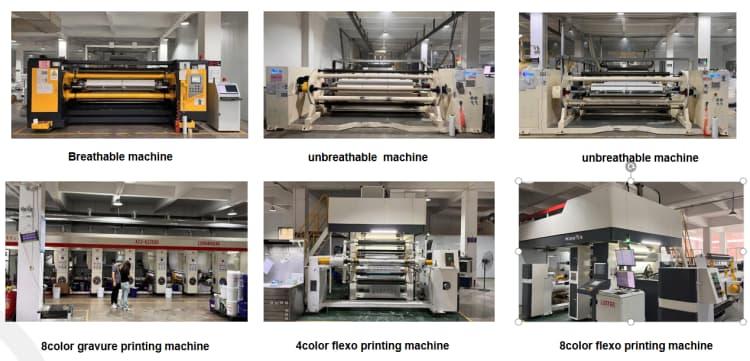
A reliable supplier should provide both consistent material quality and stable technical support.
The supplier should maintain stable:
· Width
· Thickness
· Surface structure
· Tensile strength
· Peel performance
· Roll quality
Batch-to-batch consistency is especially important for high-volume production.
A professional supplier should have appropriate inspection procedures throughout production.
Quality control may include:
· Raw material inspection
· Production monitoring
· Dimensional inspection
· Surface inspection
· Mechanical testing
· Finished roll inspection
Large hygiene manufacturers need stable material supply.
Buyers should evaluate whether the supplier can maintain:
· Stable production
· Consistent lead times
· Sufficient capacity
· Reliable packaging
· Stable shipment schedules
Different customers may require different:
· Widths
· Thicknesses
· Roll lengths
· Colors
· Material structures
· Packaging specifications
Customization can help the material fit a customer's existing production line.
Before placing a large order, buyers should request samples for production testing.
A good supplier should be able to communicate technical specifications clearly and support the testing process.
Frontal tape and side tape are important functional materials in disposable hygiene manufacturing.
Although they are relatively small components, their surface characteristics, mechanical performance, dimensional stability, and processing compatibility can directly affect the reliability of the fastening system.
When selecting these materials, buyers should evaluate:
· Material structure
· Peel performance
· Tensile strength
· Flexibility
· Surface uniformity
· Width consistency
· Dimensional stability
· Compatibility with adhesives and other materials
The most suitable material is the one that matches the customer's actual production requirements and maintains consistent performance during high-speed manufacturing.
Working with a reliable supplier can also help manufacturers reduce material variation, simplify production testing, and establish a more stable supply chain.

 MP/WhatsApp: +86-18050806553
 Manufacturer Address:Juhua Industry Matou Town, Nanan City Fujian Province China