

Hot Keyword:
Author:Baby & Adult Diaper Materials FROM:Diaper Materials Manufacturer TIME:2026-11-25
Designing disposable hygiene products involves much more than choosing a shape or selecting a few materials. Manufacturers need to understand user needs, define product structures, select suitable raw materials and evaluate how different components work together.
Products such as baby diapers, sanitary pads, adult incontinence products and disposable underpads have different usage requirements. Their structures and material combinations must be designed according to factors such as comfort, absorption, leakage protection, fit and production requirements.
This guide explains the main stages of disposable hygiene product design and how raw material selection supports the development of reliable products.
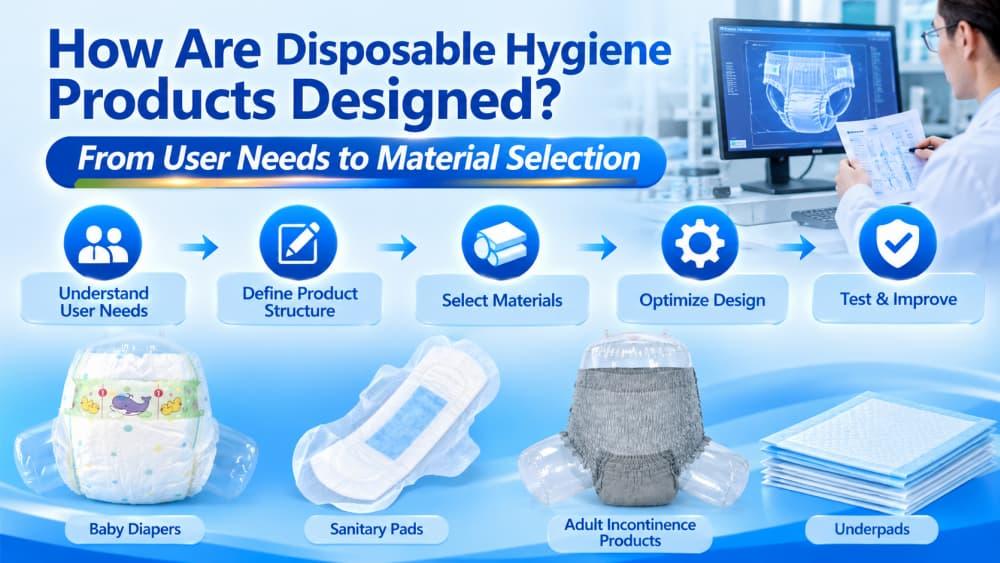
The first step in product design is understanding who will use the product. Baby diapers, adult incontinence products and sanitary pads serve different users and usage scenarios.
For example, baby diapers need to consider infant movement, delicate skin and different size requirements. Adult incontinence products may require different absorbency levels, fit designs and wearing comfort. Sanitary pads are designed around menstrual flow, body movement and discretion.
Manufacturers need to identify the main functions that the product must provide. Common requirements include liquid absorption, leakage protection, skin comfort, breathability, flexibility and secure fit.
Usage conditions influence product design. Daytime and overnight products, for example, may have different absorbency and fit requirements. Products designed for active users may need better flexibility and secure positioning.
Once user needs are understood, manufacturers can translate them into measurable product requirements. These may include product dimensions, absorbency targets, leakage protection, material softness and performance during use.
| User Requirement | Design Consideration | Possible Material Focus |
|---|---|---|
| Skin Comfort | Soft surface and suitable contact layers | Topsheet nonwoven |
| Absorption | Liquid intake and retention | SAP, fluff pulp, ADL |
| Leakage Protection | Effective liquid barrier and fit | PE film, barrier nonwoven |
| Flexibility | Adaptation to body movement | Elastic materials and flexible films |
| Breathability | Moisture and airflow management | Breathable film and nonwoven |
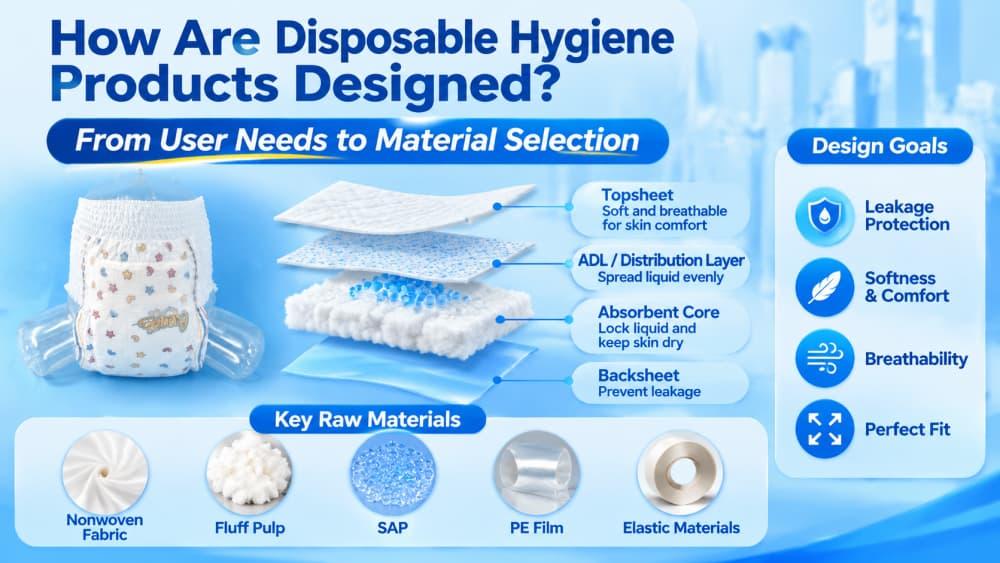
Disposable hygiene products are generally designed with multiple layers, each performing a specific function. In a typical baby diaper absorbent structure, the main layers may include a topsheet, an acquisition and distribution layer, an absorbent core and a backsheet.
The exact construction varies depending on the product type, design and manufacturer. Some products may contain additional layers or use combined materials to achieve specific performance requirements.
From the skin-contact side toward the clothing side, a simplified diaper absorbent structure can be described as follows:
| Layer | Main Function | Typical Material |
|---|---|---|
| Topsheet | Provides a soft surface and allows liquid to pass through | Hydrophilic nonwoven |
| ADL / Distribution Layer | Helps distribute liquid into the absorbent core | ADL nonwoven |
| Absorbent Core | Absorbs and retains liquid | SAP and fluff pulp |
| Backsheet | Provides a liquid barrier on the outer side | PE film or breathable backsheet material |
Other components, such as leg cuffs, elastic materials, frontal tape and side tapes, contribute to fit, flexibility and leakage protection. Their positions depend on the overall product construction.
Different disposable hygiene products require different structures. A sanitary pad, for example, generally includes a topsheet, absorbent core, backsheet and adhesive system. Adult incontinence products may use diaper-style or pull-up constructions with additional attention to fit, waist elasticity and absorbency.
Disposable underpads usually focus on surface absorption, liquid distribution and a reliable waterproof backing layer.
The topsheet is the layer that comes into direct contact with the user's skin. Its softness, liquid passage characteristics, surface structure and consistency can influence comfort and product performance.
Hydrophilic nonwoven materials are commonly used where liquid needs to pass through the surface. Material selection should consider the intended application and the required balance between softness and liquid handling.
The absorbent core is responsible for absorbing and retaining liquid. SAP and fluff pulp are commonly used in absorbent structures, with their proportions and distribution depending on the product's design targets.
Core design may influence product thickness, absorption capacity, flexibility and liquid retention. Manufacturers need to consider the balance between absorbency and the desired product profile.
The backsheet forms the outer barrier of many disposable hygiene products. PE film and breathable film materials may be selected according to requirements for liquid resistance, softness, flexibility and breathability.
The choice of backsheet material should match the product's intended use and performance requirements.
Elastic materials help products fit the body and adapt to movement. They may be used in waist areas, leg openings and other parts of diaper or pull-up constructions.
Fastening components, including frontal tape and side tapes, help secure the product and support fit adjustment. Their performance should be considered together with the product's overall structure.
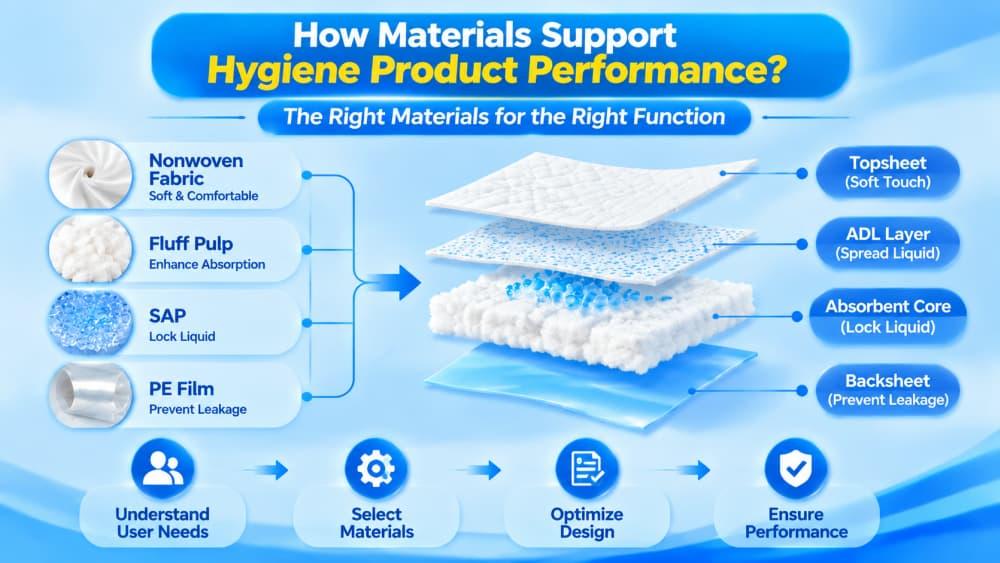
Material selection should start with the function each component needs to perform. A material that works well in one product design may not be suitable for another because the structure, processing conditions and performance targets may differ.
| Product Component | Material Options | Design Considerations |
|---|---|---|
| Skin-contact Layer | Hydrophilic nonwoven | Softness, liquid passage, surface consistency |
| Distribution Layer | ADL nonwoven | Liquid distribution and acquisition |
| Absorbent Core | SAP, fluff pulp | Absorption, retention, core thickness |
| Outer Barrier | PE film, breathable film | Leakage resistance, flexibility, breathability |
| Fit Components | Elastic materials, tapes | Stretch, recovery, fastening performance |
Many manufacturers aim to develop thinner products while maintaining the required absorption performance. This involves careful absorbent core design, material selection and liquid distribution.
Reducing thickness should not compromise the product's ability to absorb and retain liquid under its intended conditions of use.
Soft materials can improve comfort, but the overall product must also maintain sufficient strength and stability during manufacturing and use.
Manufacturers need to evaluate softness together with tensile properties, bonding performance and processing behavior.
Material cost is an important part of product development, but choosing materials based only on the lowest unit price can create quality or production risks.
A practical design should consider material consumption, production efficiency, product performance and consistency. The goal is to achieve the required product quality at a commercially reasonable cost.
| Design Objective | Potential Challenge | Evaluation Focus |
|---|---|---|
| Thinner Product | Maintaining sufficient absorption and retention | Core structure and liquid management |
| Improved Softness | Maintaining strength and processing stability | Surface feel and mechanical properties |
| Better Leakage Protection | Maintaining flexibility and comfort | Barrier performance and fit |
| Lower Material Cost | Avoiding reduced quality or higher production waste | Total cost and product performance |
After defining the product structure and selecting preliminary materials, manufacturers can develop initial samples. These prototypes help evaluate the overall design before larger-scale production.
At this stage, manufacturers may review dimensions, layer arrangement, material compatibility, appearance and basic functional performance.
Product evaluation may include absorption tests, leakage tests, rewet measurements, tensile tests and other assessments relevant to the product category.
Testing methods should reflect the intended use and the manufacturer's quality requirements. Different product types may require different evaluation procedures.
Laboratory results alone may not fully predict how a material combination will behave during mass production. Production trials help evaluate machine compatibility, feeding stability, bonding, running speed and material waste.
Based on sample evaluations and production trial results, manufacturers may adjust material specifications, layer dimensions, component positions or material combinations.
This process may be repeated until the product meets the required performance, quality and production targets.
Individual materials may perform well in isolation but behave differently when combined into a complete product structure. Compatibility between layers, adhesives and other components should therefore be considered during product development.
Variations in raw material specifications or batch quality may influence product consistency. Manufacturers need clear material requirements and incoming inspection procedures to help control these variations.
A new product design must be compatible with the manufacturer's equipment and production capabilities. Changes in material width, roll characteristics, tension requirements or bonding behavior may require production adjustments.
Product development should also consider material availability, supplier capacity, lead times and purchasing costs. A design that depends on materials with unstable supply may create challenges for long-term production planning.
Disposable hygiene product development connects several stages, from raw material sourcing and material processing to product design, manufacturing and final product evaluation. Each stage influences the next.
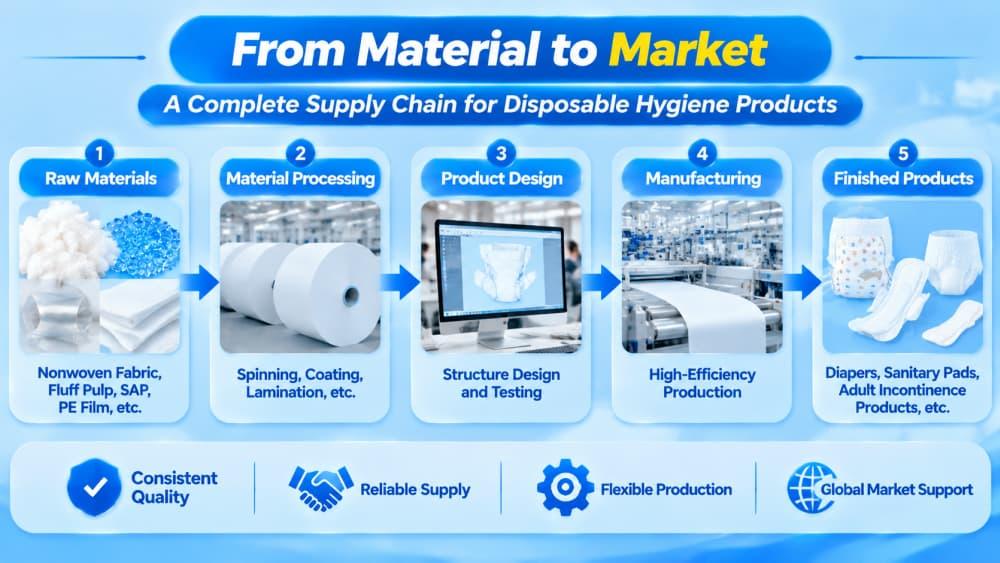
The main stages generally include understanding user needs, defining product requirements, designing the product structure, selecting materials, developing prototypes, testing performance and making design improvements.
Common materials include nonwoven fabrics, SAP, fluff pulp, PE film, ADL materials, elastic components, fastening tapes and adhesives. The exact combination depends on the product type and design.
No. Baby diapers, sanitary pads, adult incontinence products and underpads have different functional requirements. Their structures and material combinations vary according to the intended application.
Raw materials influence comfort, absorption, leakage protection, flexibility, breathability and manufacturing performance. Selecting suitable materials is essential for achieving the product's design targets.
Prototype testing helps manufacturers identify design problems before mass production. It provides information about product performance, material compatibility and possible improvements.
No. Material selection should consider technical performance, consistency, production compatibility, availability and total cost. A low purchase price may not result in the lowest overall production cost.
Disposable hygiene product design is a coordinated process that connects user requirements, product structure, raw material selection and performance evaluation.
Each material plays a specific role in the overall product. Understanding how topsheets, absorbent cores, backsheets, elastic components and other materials work together helps manufacturers make better design and purchasing decisions.
For hygiene product manufacturers, working with reliable raw material suppliers and evaluating materials according to actual product requirements can support more consistent quality, efficient production and long-term product development.

 MP/WhatsApp: +86-18050806553
 Manufacturer Address:Juhua Industry Matou Town, Nanan City Fujian Province China