

Hot Keyword:
Author:Baby & Adult Diaper Materials FROM:Diaper Materials Manufacturer TIME:2026-11-17
Baby diapers and adult incontinence products are both designed to manage urinary leakage and keep users comfortable and protected. Although they share some basic functions and raw materials, their design requirements are not exactly the same.
Baby diapers are developed for infants whose bodies are still growing and whose movement patterns change as they develop. Adult incontinence products, on the other hand, serve users with different mobility levels, body shapes and incontinence needs.
For manufacturers and raw material buyers, understanding these differences is important when selecting materials, developing product structures and planning production. This article compares the two product categories from a design, absorbency and manufacturing perspective.
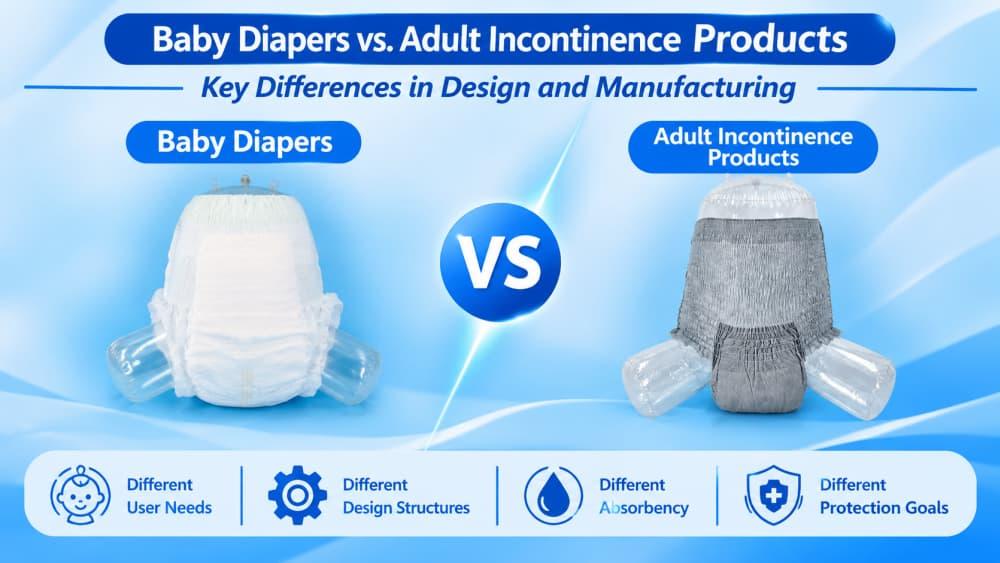
Baby diapers are designed for infants and toddlers at different stages of development. Newborns generally need soft materials and a comfortable fit, while older babies may require greater flexibility as they begin crawling, standing and walking.
Important design considerations include skin contact comfort, breathability, fit around the waist and legs, and protection against leakage during movement.
Adult incontinence products are designed for people experiencing different levels of urinary incontinence. Some users remain active and prefer pull-up products that resemble regular underwear. Others may need products with adjustable fastening systems or designs that support assisted changing.
Product requirements can vary according to the user's mobility, body shape, wearing duration and expected leakage volume. Comfort, discretion, absorbency and ease of changing are important considerations.
Both categories aim to provide reliable leakage protection, but their target users and usage conditions influence product dimensions, absorbent core design, fastening systems and material combinations.
Although both product categories may use topsheets, absorbent cores, backsheets and elastic components, their overall structures can differ according to the product type and intended application.
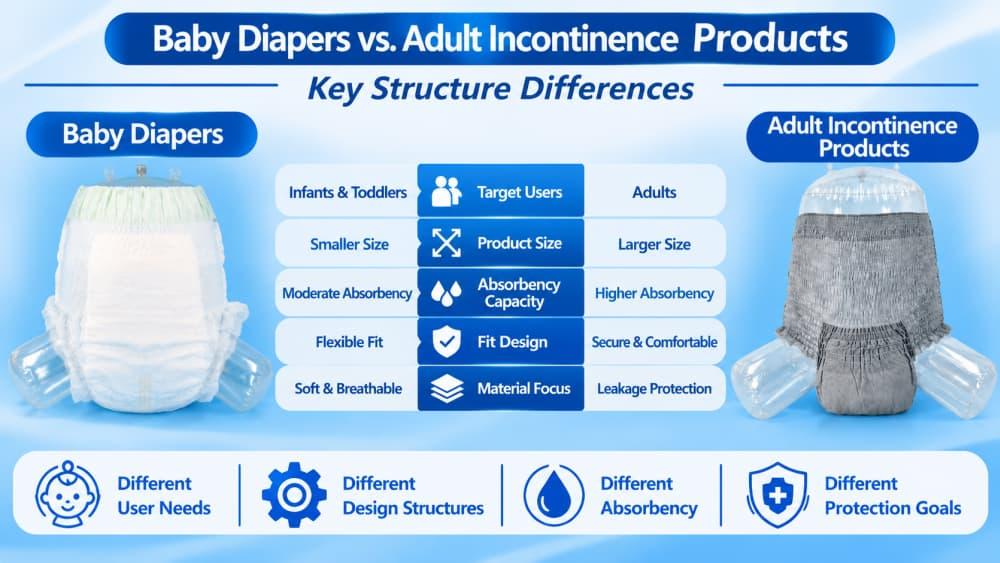
Baby diapers are generally developed in size ranges based on infant weight and growth stages. Adult incontinence products need to accommodate a wider range of body shapes and waist or hip measurements.
Consequently, adult products may require different dimensions and coverage areas, depending on whether they are designed as pull-up pants, tab-style briefs or other product formats.
The topsheet is the layer that comes into contact with the user's skin. Softness, liquid acquisition and surface dryness are important considerations for both baby and adult products.
The backsheet helps prevent liquid leakage. Depending on the product design, manufacturers may use PE film or breathable laminated structures to balance liquid barrier performance and moisture vapor transmission.
Baby diaper designs may include frontal tape, side tape and elastic waist features. These components help secure the diaper while allowing movement.
Adult products also use elastic components, but the requirements depend on the format. Pull-up products need suitable waist and leg elasticity, while tab-style products may use fastening systems that allow adjustment during wearing.
The following table summarizes the main differences between baby diapers and adult incontinence products from a product design and manufacturing perspective.
| Comparison Factor | Baby Diapers | Adult Incontinence Products |
|---|---|---|
| Target Users | Infants and toddlers at different growth stages | Adults with different levels of incontinence and mobility |
| Size Design | Usually based on baby weight and growth stages | Usually based on waist, hip measurements and body shape |
| Absorbency | Varies by size, age range and product positioning | Varies by incontinence level and intended wearing duration |
| Fit Requirements | Designed for infant movement and changing body sizes | Designed for different body shapes, mobility levels and wearing needs |
| Fastening System | May use frontal tape, side tape or pull-up designs | May use pull-up designs or adjustable tab-style fastening |
| Key Material Considerations | Softness, liquid acquisition, fit and leakage protection | Absorbency, fit, leakage protection and wearing comfort |
These are general design differences rather than fixed rules. Actual specifications depend on the product format, target users and manufacturer's performance requirements.
The absorbent core is one of the most important functional parts of both baby diapers and adult incontinence products. Its design affects liquid absorption, retention, distribution and overall product performance.
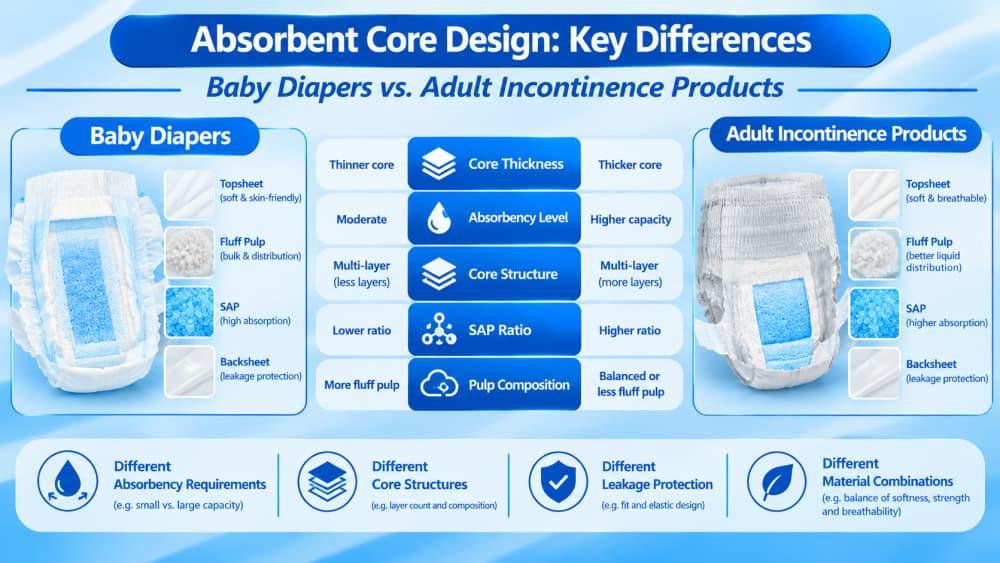
Baby diaper absorbency requirements vary by size, age range, product positioning and intended wearing time. Products for different stages may require different absorbent core dimensions and material combinations.
Adult incontinence products also cover a broad range of absorbency requirements. Some are intended for light leakage, while others are designed for heavier incontinence needs or longer wearing periods.
Super Absorbent Polymer (SAP) absorbs and retains liquid, while fluff pulp helps distribute liquid through the absorbent core and provides bulk.
Both baby and adult products may use SAP and fluff pulp, but the quantities and distribution depend on the product's absorbency targets, core structure and manufacturing specifications.
The acquisition and distribution layer, often called ADL, helps transfer liquid from the topsheet toward the absorbent core. Its structure and performance can influence how quickly liquid is distributed and how well the core uses its available absorption capacity.
Manufacturers should evaluate acquisition speed, rewet performance and liquid distribution under conditions relevant to the intended product.
A suitable fit helps reduce leakage and improve wearing comfort. Baby diapers need to accommodate frequent body movement and changes in posture. Adult products must consider differences in body shape, waist dimensions and mobility.
Elastic strands and other elastic components help products fit around the waist and legs. Their specifications should be selected according to the required stretch, recovery, bonding method and wearing comfort.
For pull-up products, waist elasticity is particularly important because the product must be pulled on and remain securely positioned during use.
Leg cuffs, standing leak guards and suitable absorbent core positioning can help reduce leakage. The exact design depends on the product format and its intended use.
Manufacturers should evaluate leakage protection together with fit, absorbency and user comfort rather than relying on a single component.
Baby diapers and adult incontinence products share many raw material categories. However, material grades, specifications and combinations should be selected according to each product's performance requirements.
Nonwoven fabric is commonly used for topsheets, leg cuffs, waist components and other structural layers. Buyers should consider softness, strength, liquid handling properties, GSM and width according to the intended application.
SAP and fluff pulp are key materials in many absorbent cores. Their selection should consider absorption performance, retention, liquid distribution, processing compatibility and the target product design.
PE film provides a liquid barrier in the backsheet structure. Breathable films or laminated materials may be selected when the product design requires a balance between liquid protection and breathability.
Elastic materials help provide a secure fit. Frontal tape and side tape may be used in relevant diaper formats, while hot-melt adhesives are used to bond different product layers.
Material compatibility is important. Buyers should consider bonding performance, processing conditions and consistency when evaluating different suppliers or specifications.
Different product formats may require different machine configurations, cutting layouts, material feeding systems and fastening processes. Manufacturers should confirm that material specifications are compatible with their production equipment.
Changes in GSM, width, thickness, elasticity or bonding properties may affect machine performance and finished product consistency. Incoming material checks and production trials help manufacturers evaluate whether a material is suitable for their process.
Individual raw material specifications cannot fully predict finished product performance. Manufacturers should evaluate the complete product through relevant tests, such as absorption, rewet, leakage, tensile strength, fit and wearing comfort.
Before selecting materials, manufacturers should define the product category, target user, size range, absorbency level and intended wearing conditions.
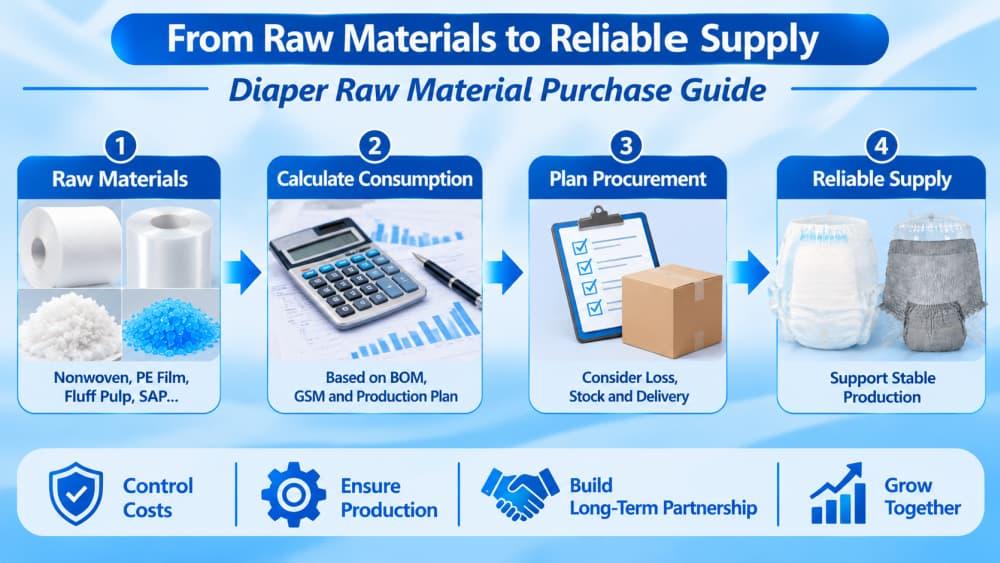
Each material should have a clear role and specification in the product bill of materials. Buyers should confirm GSM, width, thickness, roll dimensions and other relevant technical requirements before placing orders.
Material samples should be evaluated not only for appearance and basic specifications but also for machine compatibility and performance in the complete product structure.
Consistent specifications, reliable delivery schedules and clear technical communication are important when choosing raw material suppliers. Manufacturers should also consider whether suppliers can support future product development and specification adjustments.
They share many material categories, including nonwoven fabric, SAP, fluff pulp, PE film, elastic components and adhesives. However, the specifications and combinations may differ according to product design and performance requirements.
No. Absorbency varies according to product type and intended application. Some adult products are designed for light leakage, while others are developed for heavier incontinence needs. The same is true of different baby diaper product ranges.
Some nonwoven grades may be suitable for applications in both categories, but suitability must be confirmed through specifications, material testing and production trials. Softness, strength, GSM and processing compatibility should all be considered.
Buyers should review technical specifications, sample performance, production compatibility, quality consistency, packaging and delivery capability. The selected materials should meet the requirements of the specific product BOM.
Baby diapers and adult incontinence products share similar functional principles and many raw material categories, but their design priorities differ according to user needs, product formats and absorbency requirements.
For manufacturers and procurement teams, understanding these differences helps improve material selection, product development and production planning. Rather than choosing materials based only on general product categories, buyers should evaluate each material according to the actual product design, technical specifications and performance targets.
A reliable raw material supply strategy, combined with appropriate testing and production evaluation, helps manufacturers develop products that meet their intended application requirements.

 MP/WhatsApp: +86-18050806553
 Manufacturer Address:Juhua Industry Matou Town, Nanan City Fujian Province China