

Hot Keyword:
Author:Baby & Adult Diaper Materials FROM:Diaper Materials Manufacturer TIME:2026-11-13
Accurately estimating raw material consumption is an important part of diaper manufacturing and procurement planning. If buyers order too much material, inventory costs increase. If they order too little, production may be interrupted while waiting for additional supplies.
However, diaper material consumption is not determined by a single fixed formula. It depends on the diaper design, material specifications, product size, production process and actual manufacturing losses.
This guide explains how to estimate the consumption of common diaper raw materials, calculate total requirements and prepare a more reliable purchasing plan.
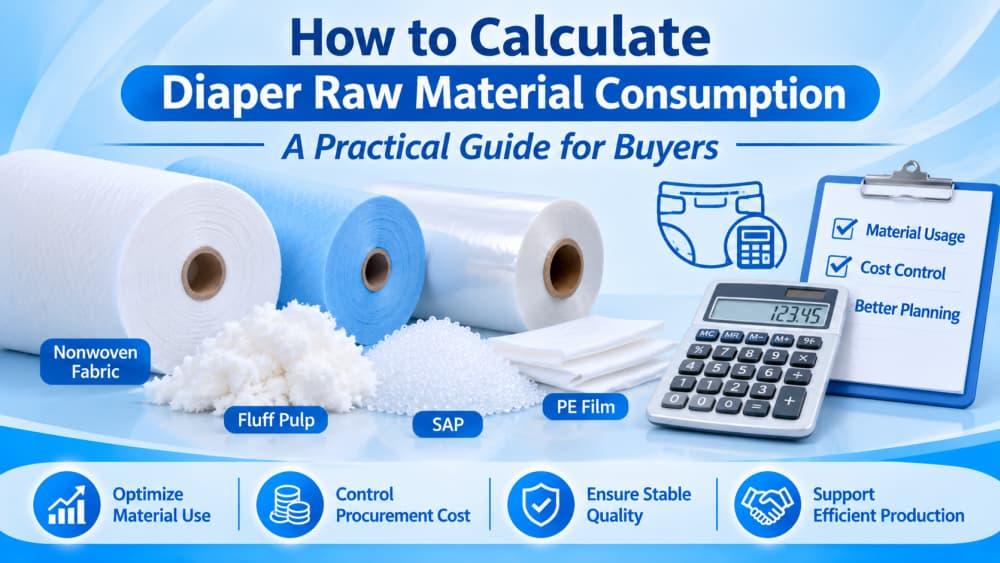
Raw materials represent a significant part of diaper manufacturing costs. Calculating the required quantity before placing an order helps buyers avoid unnecessary purchases and excessive inventory.
Insufficient material supply can delay production schedules. A reliable consumption estimate helps manufacturers arrange purchasing and delivery according to their production plans.
Consumption records allow manufacturers to compare theoretical usage with actual production data. This makes it easier to identify unexpected waste, adjust purchasing quantities and improve cost management.
Before calculating material requirements, buyers should collect the correct technical and production information.
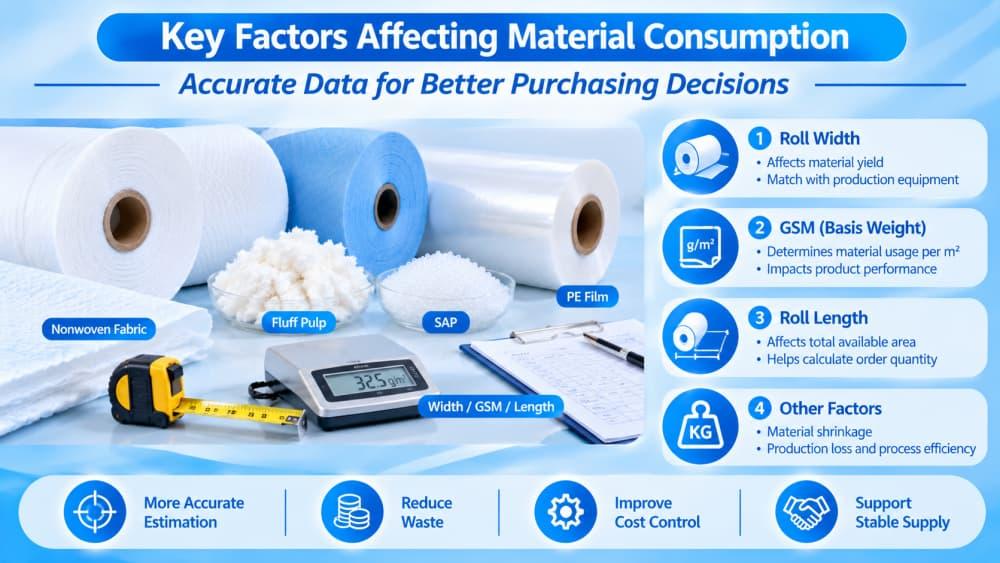
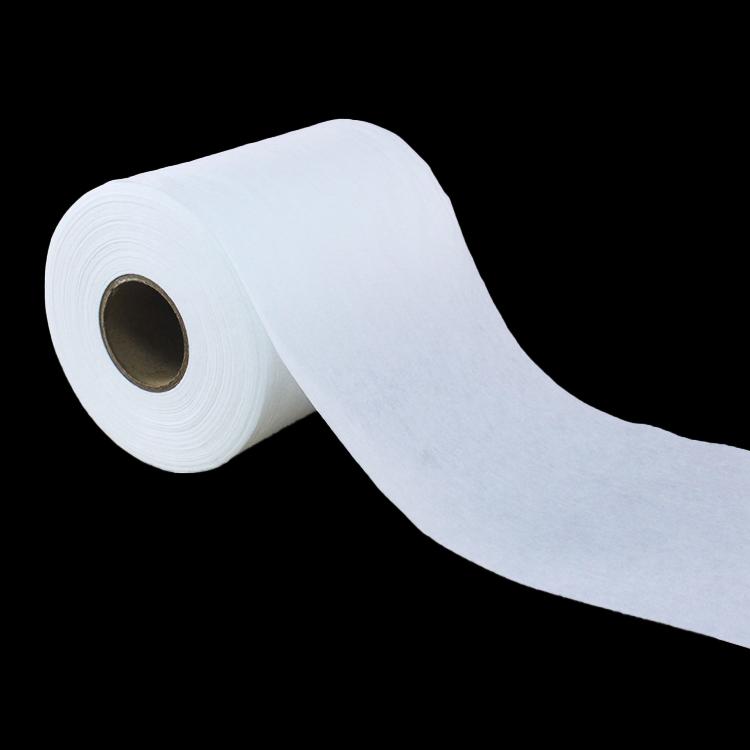
For roll materials such as nonwoven fabric and PE film, roll width affects how efficiently the material can be used. The cutting layout, number of lanes and diaper dimensions determine how much material is consumed by each product.
GSM refers to grams per square meter. For materials measured by area, a higher GSM means more material weight is required for the same coverage area.
Different diaper sizes require different material dimensions. Larger products may use more topsheet, backsheet, leg cuff material and absorbent core materials than smaller products.
Material loss can occur during machine startup, splicing, cutting, adjustment and normal production. Actual loss rates should be calculated from factory production records rather than assumed to be the same for every material.
Nonwoven fabric is used in several diaper components, including the topsheet, leg cuffs, waist areas and other structural parts. Each component should be calculated separately according to its specifications.
First, determine the material area required for one diaper component. The calculation should consider the cutting dimensions and the number of pieces used in each diaper.
When dimensions are measured in meters, the result is expressed in square meters. For complex cutting layouts, use the actual machine layout or production data rather than the finished component dimensions alone.
Once the material area is known, multiply it by the specified basis weight.
Add the consumption of all nonwoven components used in one diaper. Then multiply the result by the planned production quantity.
For example, if the calculated nonwoven consumption is 8 grams per diaper and the production plan is 500,000 pieces, the theoretical net requirement is 4,000 kg. This example is for calculation purposes only; actual consumption must come from the product BOM and cutting specifications.
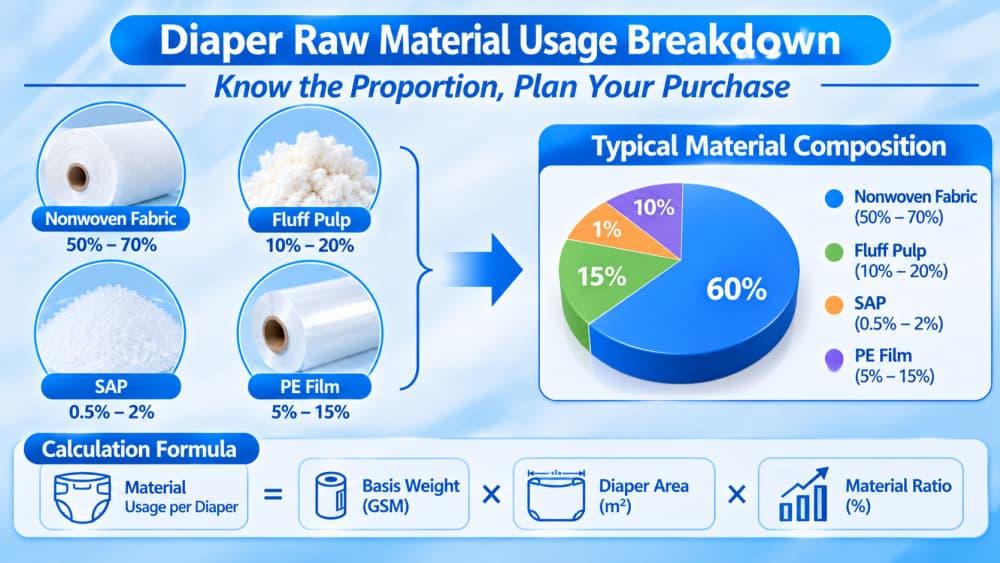
Super Absorbent Polymer (SAP) is used in the absorbent core to retain liquid. Its consumption depends on the product's absorbency requirements, core design and formulation.
The most reliable method is to obtain the SAP weight per diaper from the approved BOM or production formulation.
Fluff pulp provides bulk and helps distribute liquid within the absorbent core. Its usage depends on the core structure, pulp weight and the balance between fluff pulp and SAP.
Use the specified fluff pulp weight per diaper from the product formulation. If the core contains multiple layers or sections, calculate each section separately and then add the results.
SAP and fluff pulp should not be estimated independently of the core design. Their respective quantities need to match the product's performance requirements and approved production formula.
PE film is commonly used as the backsheet or as part of a breathable backsheet structure. Its weight can be estimated using the material area and GSM.
For laminated or composite structures, calculate each layer according to its own specifications and avoid counting the same area twice.
Other materials may include elastic strands, frontal tape, side tape, adhesive and acquisition distribution layer materials. Their calculation methods vary according to product design.
For tape materials, use the length or area consumed per diaper and the material's weight per unit. For elastic materials, use the specified number of strands, cut length and material specifications. For adhesives, use the application rate and the relevant production area.
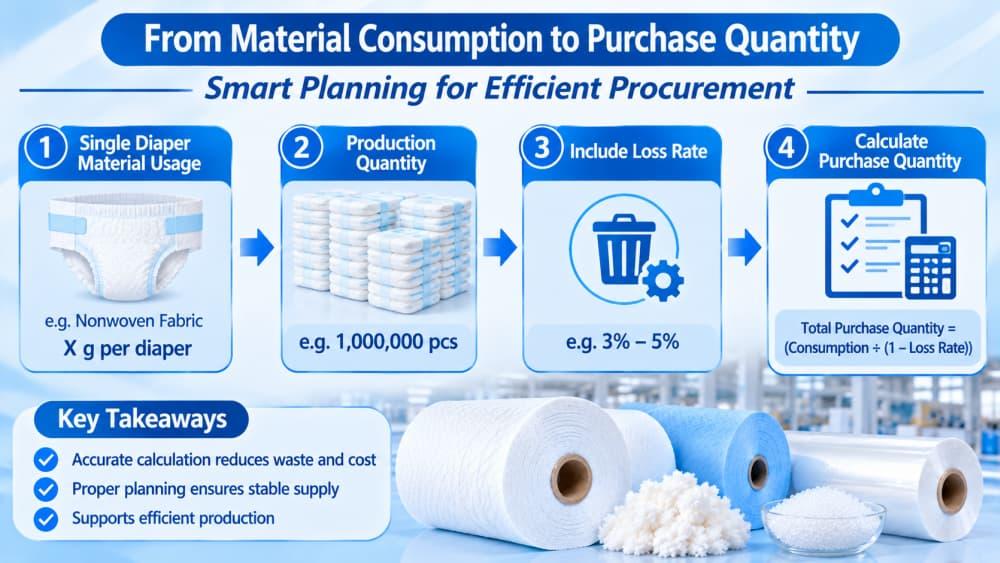
For each raw material, multiply the verified consumption per diaper by the planned production quantity. Convert grams into kilograms when necessary.
Production loss should be based on historical data or a validated production trial. It may vary according to material type, machine settings, roll changes, product design and operating conditions.
If the loss rate represents the percentage of input material that becomes waste, use:
For example, if net material consumption is 4,000 kg and the actual loss rate is 4% of total input, the required input quantity is approximately 4,166.7 kg.
If a factory instead uses a purchasing allowance calculated as a percentage added to net consumption, the formula is different:
Buyers should confirm which calculation method is used in their factory to avoid adding the same loss twice.
After calculating the required weight, check the supplier's roll weight, roll length, width, packaging and minimum order quantity. The final order may need to be rounded up to complete rolls or standard packaging units.
Consider current stock, materials already on order, expected delivery dates and the production schedule. The final purchase order should cover the actual shortage rather than automatically ordering the full calculated requirement.
Different diaper sizes have different dimensions and material requirements. Calculate each size separately using its own BOM and cutting specifications.
Two materials with the same dimensions may have different weights if their GSM values differ. Always verify the latest technical specifications before calculating material weight.
Actual production loss varies between factories and production lines. Use recorded consumption and output data instead of applying an arbitrary percentage to every material.
Theoretical net consumption does not include production waste, while purchase quantity may also need to account for roll packaging, minimum order quantities and available inventory. Keep these figures separate in procurement records.
A preliminary estimate may be possible using product dimensions and material specifications. However, an accurate calculation requires the actual BOM, cutting layout or verified production consumption data.
No. GSM indicates the weight per square meter, but buyers also need the material area used per diaper. Both values are required to estimate material weight.
It should be recorded separately from theoretical net consumption. When calculating purchase quantity, apply the factory's actual loss rate or purchasing allowance using a clearly defined calculation method.
Review consumption whenever the product design, material specification, machine settings or production process changes. Regular comparisons between BOM estimates and actual production records also help identify differences.
Accurate diaper raw material consumption calculations help manufacturers control procurement costs, reduce unnecessary inventory and maintain stable production schedules.
The key is to calculate each material according to its actual specifications and product requirements. Nonwoven fabric and PE film can generally be estimated using GSM and material area, while SAP and fluff pulp should be based on the approved absorbent core formulation.
By combining verified BOM data, production quantities and actual loss records, buyers can make more reliable purchasing decisions and manage raw material requirements more efficiently.

 MP/WhatsApp: +86-18050806553
 Manufacturer Address:Juhua Industry Matou Town, Nanan City Fujian Province China