

Hot Keyword:
Author:Baby & Adult Diaper Materials FROM:Diaper Materials Manufacturer TIME:2026-09-22
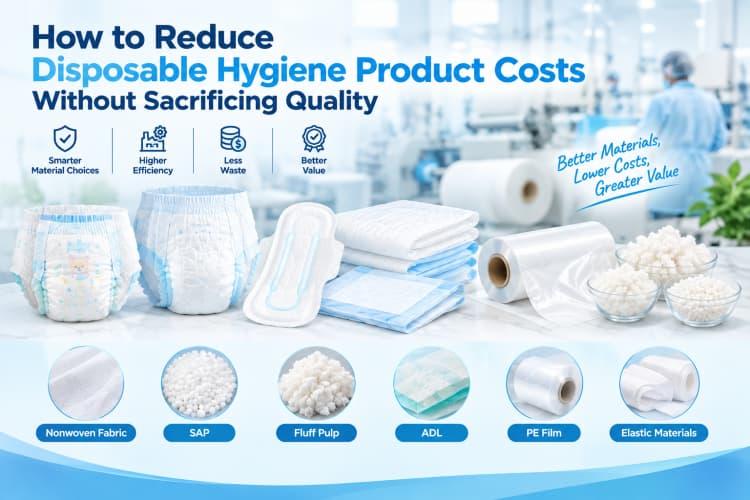
Cost control is an important part of disposable hygiene product manufacturing. Whether producing baby diapers, sanitary napkins, adult incontinence products, underpads, or other absorbent hygiene products, manufacturers need to control costs while maintaining stable product performance.
Raw materials are one of the most important cost factors, but they are not the only one. Material specifications, production waste, machine efficiency, quality consistency, packaging, logistics, and supplier reliability can all affect the final cost.
For this reason, reducing costs does not simply mean purchasing cheaper materials.
A better approach is to understand where costs come from, select materials according to actual product requirements, reduce unnecessary waste, and evaluate suppliers based on total value rather than unit price alone.
This article explains practical ways for disposable hygiene manufacturers and procurement teams to reduce overall production costs without sacrificing product quality.
Disposable hygiene products are produced in high volumes, which means even a small change in material consumption or production efficiency can have a significant impact on total manufacturing costs.
For example, if a manufacturer uses slightly more nonwoven fabric, absorbent material, PE film, or elastic material in every product, the additional consumption can become substantial when multiplied across millions of units.
Cost optimization therefore needs to consider the entire production process rather than one individual material.
A common mistake is to focus only on reducing the purchase price of raw materials.
A cheaper material may create other costs if it has inconsistent specifications, poor processing performance, higher production waste, or unstable quality.
For example, a material with a lower unit price may require higher consumption to achieve the same product performance. In this situation, the apparent saving in purchase price may not result in a lower actual production cost.
Manufacturers should consider the total cost associated with a material.
This can include:
· Material purchase price
· Material consumption
· Production waste
· Machine efficiency
· Quality inspection
· Rework and rejected products
· Packaging
· Transportation
· Inventory
· Product complaints
Looking at these factors together provides a more realistic picture of manufacturing cost.
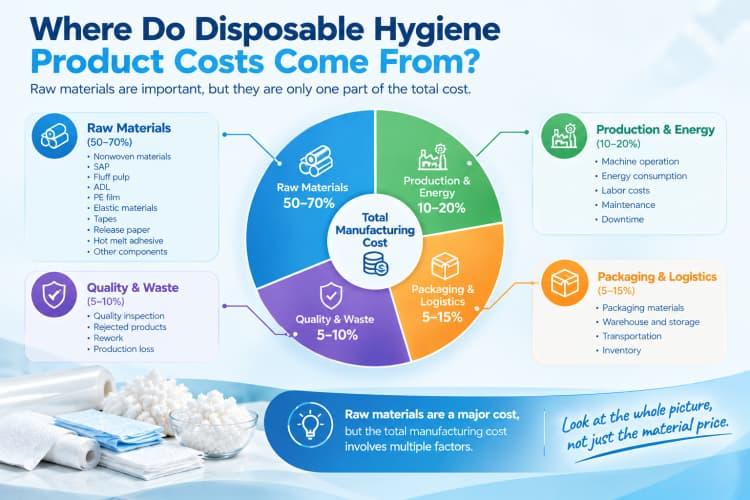
Raw materials normally represent a major part of disposable hygiene product manufacturing costs.
Depending on the product, materials may include:
· Nonwoven materials
· SAP
· Fluff pulp
· ADL
· PE film
· Elastic materials
· Tapes
· Release paper
· Hot melt adhesive
· Other functional components
The cost of each material depends not only on its price but also on its specification, consumption, and role in the final product.
Manufacturing costs also include the operation of production lines.
Machine speed, energy consumption, labor requirements, maintenance, downtime, and production efficiency can all affect the cost per unit.
A material that runs smoothly at high production speed may provide better overall economics than a cheaper material that frequently causes machine adjustments or production interruptions.
Packaging and transportation should also be included when calculating the actual cost of materials.
A material with a low purchase price may require more warehouse space or have inefficient packaging. Long transportation distances, low loading efficiency, and frequent small shipments can also increase the total cost.
Material quality problems can create additional costs through rejected products, rework, production interruptions, and customer complaints.
Consistent raw material quality can therefore contribute to cost control even when the purchase price is not the lowest available.
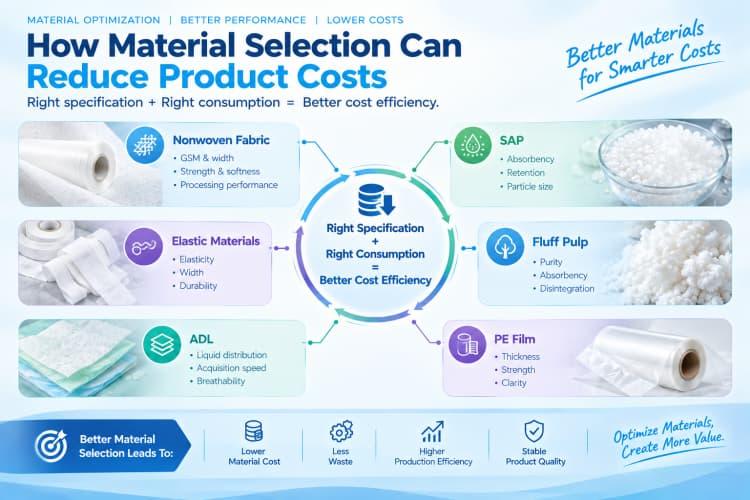
Not every product requires the same material specifications.
For example, a premium adult incontinence product may require different performance characteristics from an economy product. Similarly, different diaper sizes and product structures may require different material widths, GSM, elasticity, or absorbency requirements.
The first step is therefore to define the actual product requirements.
Manufacturers should avoid paying for specifications that do not provide meaningful value to the finished product.
Material specifications can have a direct impact on consumption.
For example, when selecting nonwoven materials, manufacturers may need to consider:
· GSM
· Width
· Strength
· Softness
· Elongation
· Processing performance
The same principle applies to PE film, elastic materials, tapes, ADL, and other components.
The objective is not simply to choose the lowest GSM or thinnest material. The objective is to find a specification that provides the required performance with efficient material consumption.
Reducing material consumption too aggressively can negatively affect product performance.
For absorbent products, for example, the absorbent core needs to achieve the required absorption, retention, distribution, and leakage protection.
SAP and fluff pulp therefore need to be considered as part of an overall absorbent system rather than simply as individual cost items.
The same principle applies to other product components. Cost optimization should maintain the required functional performance.
Over-specification is another potential source of unnecessary cost.
If a product only requires a certain level of strength, thickness, width, elasticity, or other performance characteristic, selecting a substantially higher specification may increase costs without providing a corresponding product benefit.
Manufacturers can review each material specification and ask:
Is this specification required by the product, or is it simply higher than necessary?
This question can help identify opportunities for controlled cost reduction.
Material width should match the production process as closely as possible.
Incorrect width specifications can create unnecessary edge trim and material waste.
Roll length and packaging configuration can also affect production efficiency and material handling.
When purchasing materials, manufacturers should consider how the supplied roll will be used on the actual production line.
Material defects can result in finished-product rejection.
Common problems may include:
· Uneven material
· Inconsistent GSM
· Width variation
· Poor bonding
· Surface defects
· Inconsistent elasticity
· Moisture or other specification issues
Stable raw materials can help reduce production interruptions and defective products.
Manufacturers can analyze material consumption across the production line to identify where waste occurs.
Useful measurements may include:
· Material input
· Finished-product output
· Production scrap
· Edge trim
· Start-up waste
· Changeover waste
· Rejected products
Tracking these numbers makes it easier to identify areas where improvements can be made.
Even when the specification is correct, large variations between batches can create production problems.
For example, changes in material thickness, elasticity, moisture, or physical properties may require machine adjustments.
Consistent materials can reduce unnecessary adjustments and make production more predictable.
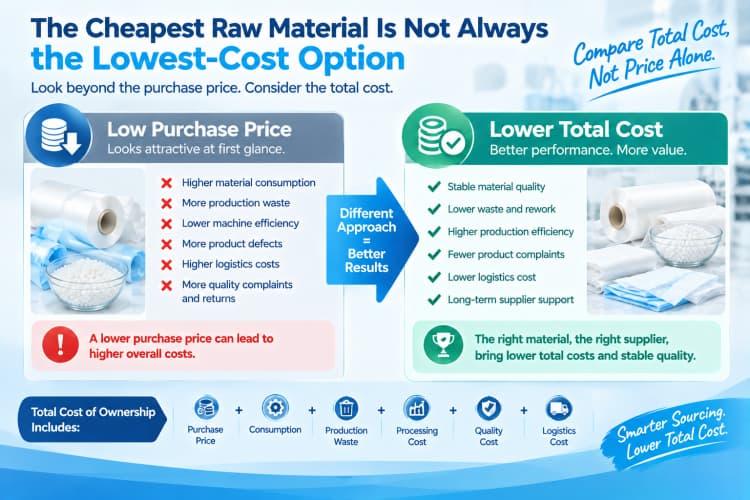
A low purchase price can be attractive, but it does not necessarily represent the lowest total cost.
A material that causes more waste, production problems, or finished-product defects can ultimately cost more.
Procurement teams should therefore consider the relationship between purchase price and actual production performance.
Material compatibility with the production line is important.
A material that can run continuously at the required production speed may provide better overall efficiency than a cheaper material that frequently causes stoppages or adjustments.
This is particularly important for high-volume manufacturing.
Finished-product quality problems can create costs after production.
Complaints, returns, replacement products, and customer service all require resources.
For B2B manufacturers, unstable quality can also affect relationships with brand customers and distributors.
When comparing two raw materials, manufacturers should consider:
Purchase Price + Consumption + Waste + Processing Cost + Quality Cost + Logistics Cost
This broader approach provides a better basis for purchasing decisions than comparing unit prices alone.
Before comparing prices, buyers should confirm that the materials being compared actually have comparable specifications.
Important factors may include:
· Material type
· Grade
· GSM
· Width
· Thickness
· Physical properties
· Functional performance
· Tolerance
· Test method
A lower price for a different specification is not necessarily a meaningful cost advantage.
Suppliers should be evaluated based on their ability to provide stable quality over repeated orders.
Buyers can compare:
· Sample quality
· Production batch quality
· Specification consistency
· Packaging
· Inspection documents
· COA availability
Consistency is especially important when materials are used in continuous production.
Minimum order quantity and lead time can influence inventory costs.
A supplier with a very low unit price may still be less suitable if the MOQ is too large or the lead time requires excessive inventory.
Manufacturers should consider how purchasing conditions fit their actual production schedule.
A stable supply is important for long-term production planning.
Buyers should consider whether the supplier can maintain:
· Consistent specifications
· Stable production capacity
· Predictable lead times
· Reliable packaging
· Regular communication
Supply stability can reduce the risk of production interruptions caused by material shortages.
Technical communication can also create value.
A supplier that can provide TDS information, technical specifications, samples, and application guidance may help buyers evaluate materials more efficiently.
This is especially useful when manufacturers are developing new products or changing product structures.
Before making a cost-reduction decision, manufacturers can review the following questions.
· What performance does the finished product actually require?
· Which specifications are essential?
· Are any materials over-specified?
· Can material consumption be optimized?
· Is the supplied width suitable for the production line?
· Is production scrap within a reasonable range?
· Is the material quality consistent between batches?
· Are there recurring production defects?
· Does the material perform consistently on the production line?
· Is the supplier reliable?
· Are lead times predictable?
· Can the supplier maintain the same specifications over repeated orders?
· Can the supplier provide technical documentation?
· Have logistics costs been included?
· Have production losses been considered?
· Have quality-related costs been considered?
· Is the lower purchase price actually reducing the total cost?
Reducing the cost of disposable hygiene products does not simply mean buying cheaper raw materials.
A more sustainable approach is to optimize the entire production system: understand product requirements, select appropriate material specifications, reduce waste, improve material utilization, maintain consistent quality, and evaluate suppliers based on total cost rather than unit price alone.
For hygiene manufacturers, the most effective cost strategy is often to find the right balance between performance, material consumption, production efficiency, quality consistency, and supply stability.
When these factors are considered together, manufacturers can identify meaningful cost-saving opportunities while continuing to deliver reliable disposable hygiene products to the market.

 MP/WhatsApp: +86-18050806553
 Manufacturer Address:Juhua Industry Matou Town, Nanan City Fujian Province China