

Hot Keyword:
Author:Baby & Adult Diaper Materials FROM:Diaper Materials Manufacturer TIME:2026-09-17
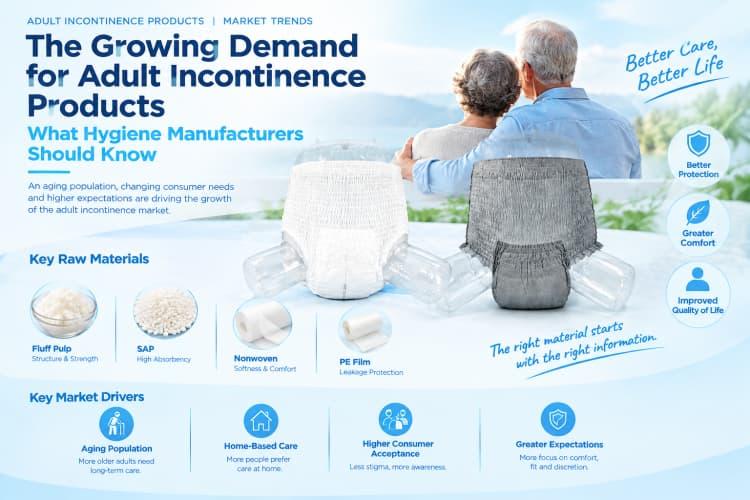
Adult incontinence is becoming an increasingly important segment of the disposable hygiene industry. Aging populations, greater awareness of continence care, home-based care, and changing consumer expectations are all creating demand for better incontinence products.
At the same time, users are no longer looking only for maximum absorbency. Comfort, fit, discretion, skin friendliness, leakage protection, and ease of use are becoming equally important.
For hygiene manufacturers, this means adult incontinence products require a more carefully balanced product structure and material selection strategy.
This article looks at the major changes in the adult incontinence market and explains what manufacturers should consider when developing high-performance products.
Population aging is one of the major factors supporting long-term demand for adult incontinence products.
As the number of older adults increases, demand for products used in home care, hospitals, nursing facilities, and daily personal care is also expected to increase.
However, the market is not limited to elderly users. Adults with different health conditions, mobility limitations, or temporary continence needs may also require absorbent hygiene products.
This creates demand across several product categories, including adult diapers, protective underwear, pads, liners, and underpads.
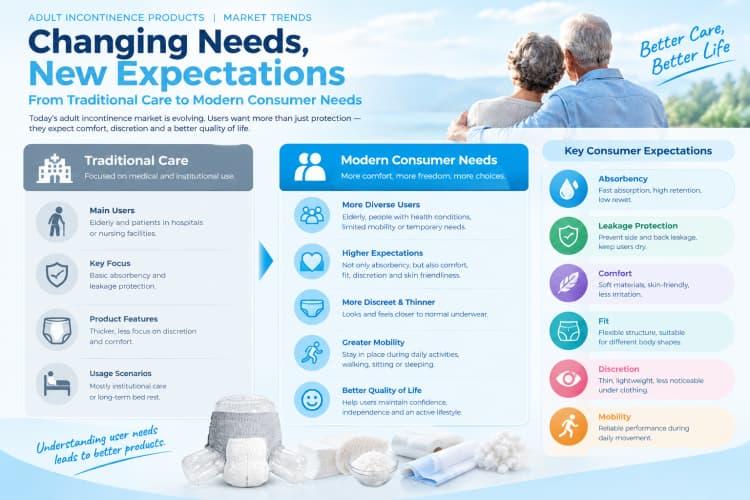
Adult incontinence products were traditionally associated mainly with medical or institutional care.
Today, many users want products that allow them to maintain a more normal and active lifestyle.
They may expect products to be:
· More discreet
· Thinner
· More comfortable
· Easier to wear
· More secure during movement
· Less noticeable under clothing
For manufacturers, this means product development needs to consider both performance and user experience.
Adult users have different body shapes, activity levels, leakage conditions, and usage environments.
For example, a product designed for an active user may require a different balance of flexibility, fit, and discretion than a product designed primarily for bedridden or high-care users.
Manufacturers therefore need to define the target user before selecting materials and designing the product structure.
Absorbency remains fundamental, but it is only one part of overall product performance.
A high-quality adult incontinence product may need to provide:
· Fast fluid absorption
· Effective fluid distribution
· Good retention
· Low rewet
· Leakage protection
· Comfortable fit
· Adequate breathability
These characteristics work together rather than independently.
Fit is particularly important for adult incontinence products because users may wear them for extended periods.
An effective product should stay in position while walking, sitting, sleeping, or changing body position.
Elastic components, appropriate dimensions, flexible materials, and suitable product construction can all contribute to better fit.
Absorption capacity is one of the most important performance requirements.
The absorbent core needs to take in liquid efficiently and retain it during use.
SAP and fluff pulp are commonly used together because they provide different but complementary functions within the absorbent core.
The exact balance depends on product type, target absorbency level, product thickness, and manufacturing process.
Preventing leakage is essential for both user confidence and product performance.
Leakage protection can involve several parts of the product structure, including the absorbent core, backsheet, leg barriers, elastic systems, and side construction.
A product with high absorption capacity can still perform poorly if fluid is not distributed effectively or if the structure does not provide adequate leakage protection.
Liquid needs to move away from the initial point of contact and into the absorbent core.
The Acquisition Distribution Layer (ADL) can help distribute fluid more efficiently and reduce localized saturation.
This becomes particularly important when the product needs to handle larger amounts of liquid within a short period.
Adult incontinence products may remain in contact with the skin for long periods.
Therefore, moisture management, softness, airflow, and skin comfort are important considerations.
Breathable backsheet materials and skin-friendly nonwoven materials can contribute to a more comfortable product structure.
Performance evaluation should consider not only absorption but also moisture management, breathability, and the user's overall wearing experience.
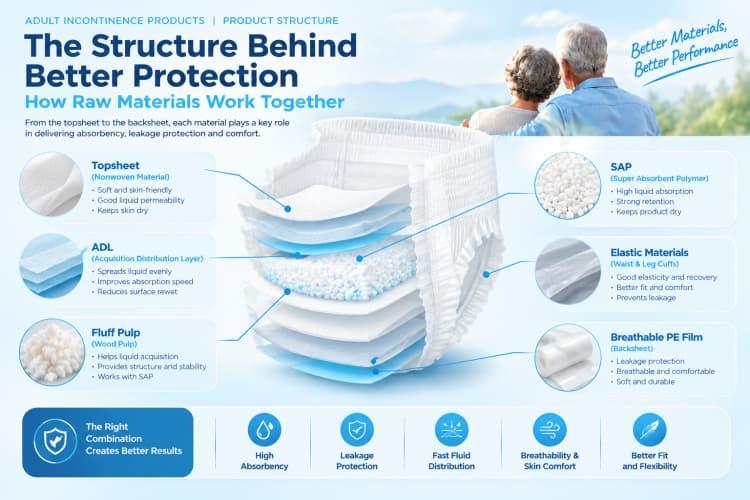
SAP and fluff pulp are central components of many absorbent cores.
SAP provides high liquid absorption and retention capacity, while fluff pulp helps with liquid acquisition, distribution, and core structure.
The right combination can help manufacturers achieve a balance between absorbency, thickness, retention, and cost.
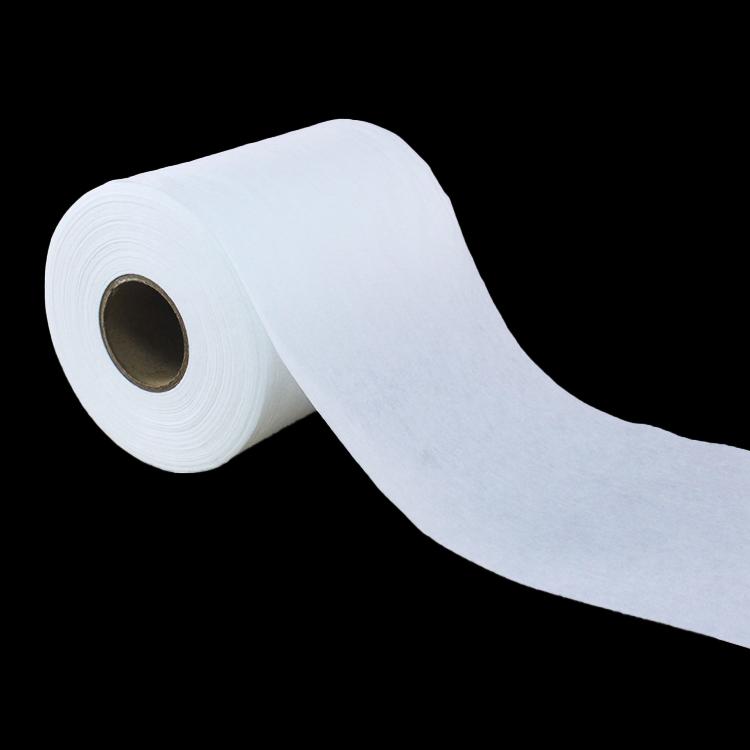
Nonwoven materials are used in several parts of an adult incontinence product.
Depending on the product design, nonwoven materials may be used for the topsheet, acquisition layer, cuffs, or other structural components.
Important considerations can include:
· Softness
· GSM
· Tensile strength
· Elongation
· Liquid handling
· Air permeability
· Machine compatibility
Material selection should be based on the specific position and function of the component rather than simply choosing a material by name.
The ADL plays an important role in fluid distribution.
Its structure and liquid-handling characteristics can affect how quickly fluid moves into the absorbent core.
For higher-performance products, manufacturers need to consider the relationship between the ADL, topsheet, absorbent core, and fluid-entry point as a complete system.
The backsheet needs to provide leakage protection while, depending on the product design, also supporting breathability.
Elastic materials are equally important for maintaining fit around the legs, waist, or other areas.
These components demonstrate why adult incontinence product performance cannot be determined by the absorbent core alone.
Consumers increasingly expect products that provide strong protection without unnecessary bulk.
Manufacturers are therefore looking for ways to improve material efficiency and absorbency while reducing product thickness.
This may involve optimizing the absorbent core, improving fluid distribution, and using materials more efficiently.
A product needs to remain secure during movement without creating excessive pressure or discomfort.
Elastic materials, leg cuffs, waist structures, and overall product dimensions all contribute to fit.
For protective underwear and pull-up products, stretch and recovery are especially important because the product needs to accommodate body movement.
Comfort is closely related to the materials that come into contact with the skin.
Soft nonwoven materials, effective moisture management, appropriate breathability, and reduced rewet can all contribute to a better wearing experience.
For manufacturers targeting premium products, material selection can therefore become an important part of product differentiation.
The adult incontinence category includes more than traditional adult diapers.
Manufacturers can develop products for different levels of protection and different usage situations, such as:
· Adult briefs
· Protective underwear
· Absorbent pads
· Liners
· Underpads
· Overnight products
This allows manufacturers to serve different customer groups rather than relying on a single product format.
As consumer demand develops in different markets, local hygiene brands and private-label manufacturers may have opportunities to enter or expand within the adult incontinence category.
These companies may need flexible manufacturing, reliable raw material supply, and the ability to customize product specifications.
This creates opportunities for manufacturers that can respond to different product requirements while maintaining consistent quality.
The adult incontinence market is becoming more segmented.
Instead of developing one general product for all users, manufacturers can consider products based on:
· Absorbency level
· Gender
· Activity level
· Product format
· Daytime or overnight use
· Home care or institutional care
More specialized products can provide better solutions for specific user needs.
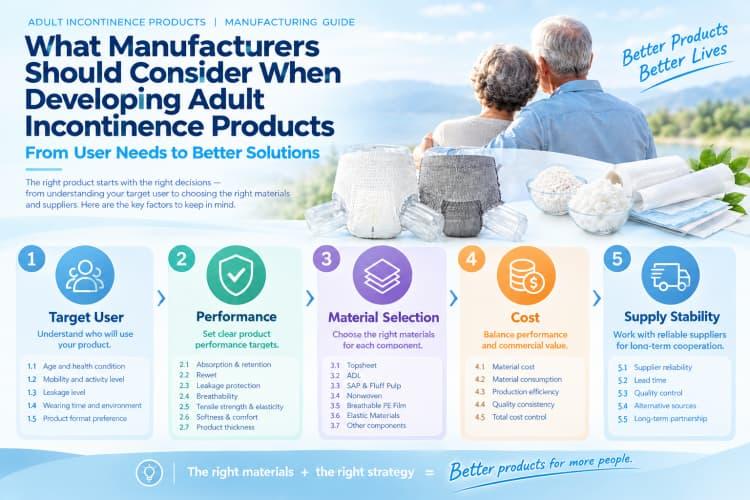
Before selecting materials, manufacturers should understand who will use the product.
Age, mobility, leakage level, wearing time, application method, and usage environment can all influence the product design.
Manufacturers should establish clear performance targets before choosing materials.
These may include absorption, retention, rewet, leakage protection, breathability, tensile strength, elasticity, softness, and product thickness.
Clear requirements make it easier to evaluate raw materials and suppliers.
No single material determines the performance of an adult incontinence product.
The topsheet, ADL, absorbent core, backsheet, elastic components, cuffs, and fastening systems need to work together.
Changing one material may affect other parts of the structure.
Therefore, material selection should be evaluated at the product-system level rather than by looking at individual specifications alone.
High performance is important, but commercial products also need to remain economically viable.
Manufacturers should consider:
· Material cost
· Material consumption
· Production efficiency
· Quality consistency
· Supplier reliability
· Lead time
· Availability of alternative sources
A material that performs well in laboratory testing may not always be the best commercial choice if its cost or supply stability is unsuitable.
The adult incontinence market is becoming an increasingly important part of the disposable hygiene industry.
However, future growth will not simply depend on producing products with higher absorbency. Manufacturers will need to balance absorption, leakage protection, comfort, fit, breathability, discretion, cost, and supply stability.
Raw materials play an important role in achieving this balance. SAP, fluff pulp, nonwoven, ADL, breathable PE film, elastic materials, and other components each contribute to the final product's performance.
For hygiene manufacturers, understanding these changing requirements can help guide better product development and more effective raw material decisions.
The opportunity is not simply to produce more adult incontinence products, but to develop products that provide better protection, greater comfort, and a better everyday user experience.
 MP/WhatsApp: +86-18050806553
 Manufacturer Address:Juhua Industry Matou Town, Nanan City Fujian Province China