

Hot Keyword:
Author:Baby & Adult Diaper Materials FROM:Diaper Materials Manufacturer TIME:2026-09-03
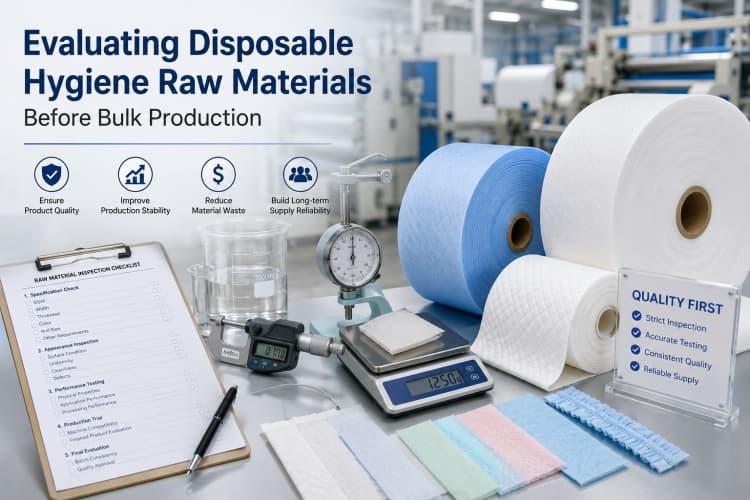
For manufacturers of disposable hygiene products, raw material quality has a direct influence on production stability and finished product performance.
Materials such as nonwovens, PE film, release paper, elastic materials, tapes, and other functional components may look similar when they are first received. However, differences in specifications, physical properties, material structure, and processing performance can affect how they perform during production.
For this reason, buyers should not evaluate a new hygiene raw material based only on its appearance or price.
A more reliable approach is to evaluate the material step by step, starting with the technical specifications, followed by sample inspection, performance testing, and production trials.
This process can help manufacturers identify potential quality issues before placing a large order.
This guide explains how buyers can evaluate disposable hygiene raw materials before moving from sample testing to bulk production.
Raw materials are important components of disposable hygiene products.
The properties of each material can affect the structure and performance of the finished product.
For example, materials used in diapers, sanitary napkins, and adult incontinence products need to work together as part of a complete product structure.
A material that does not meet the required specifications may affect the performance of the final product.
Raw material quality can also affect manufacturing stability.
A material may meet basic requirements but still create problems during high-speed production if its dimensions, structure, or physical properties vary excessively.
Stable raw materials can help manufacturers maintain more consistent production conditions.
Poor-quality raw materials can increase production waste.
Material defects may result in:
· Production interruptions
· Rejected materials
· Product defects
· Additional machine adjustments
· Increased material consumption
Evaluating samples before bulk production can help identify potential problems earlier.
Quality evaluation should not stop after the first sample passes testing.
Manufacturers also need to consider whether the supplier can maintain consistent quality from one production batch to another.
Long-term consistency is particularly important when the same material is used continuously in high-volume production.
The first step is to understand the technical specifications of the material.
Depending on the product, buyers may need to confirm:
· Material type
· GSM
· Width
· Thickness
· Color
· Roll dimensions
· Packaging requirements
· Application
The exact specifications should be agreed between the buyer and supplier before testing.
A raw material should always be evaluated according to its intended application.
For example, a material intended for a diaper elastic waistband may have different requirements from a material used for an ADL layer.
The question is not simply whether the material is “good,” but whether it is suitable for the intended application.
Buyers should consider how the new material will work with the other components of the product.
Depending on the application, this may include compatibility with:
· Topsheet
· Backsheet
· Absorbent core
· SAP
· Fluff pulp
· Adhesive
· Elastic components
· Tapes
A material that performs well by itself may still require additional testing within the complete product structure.
Before testing, buyers should request the relevant technical information from the supplier.
Depending on the material, this may include:
· Product specifications
· Technical data
· Packaging information
· Test information
· Available sizes
· Available colors
· Application information
The purpose is to establish a clear reference for sample evaluation.
The first evaluation is usually a visual inspection.
Buyers should check whether the sample has an appearance consistent with the agreed specifications.
Depending on the material, inspection may include:
· Surface condition
· Color
· Uniformity
· Cleanliness
· Visible defects
· Roll appearance
· Material edges
Visual inspection cannot replace performance testing, but it is a useful first step.
For many hygiene raw materials, GSM and dimensions are important technical specifications.
Buyers should verify whether the actual material is within the agreed specification.
Depending on the product, dimensions may include:
· GSM
· Width
· Thickness
· Roll length
· Roll diameter
The appropriate tolerance should be agreed according to the material and application.
For roll materials, the roll condition should also be checked.
Buyers can inspect:
· Roll winding
· Edge condition
· Core condition
· Packaging
· Protection during transportation
· Visible contamination or damage
Good packaging helps protect the material before it reaches the production line.
The material should also be checked for consistency across the roll.
A sample taken from one point may not always represent the entire roll.
For important materials, buyers may consider checking samples from different positions when appropriate.
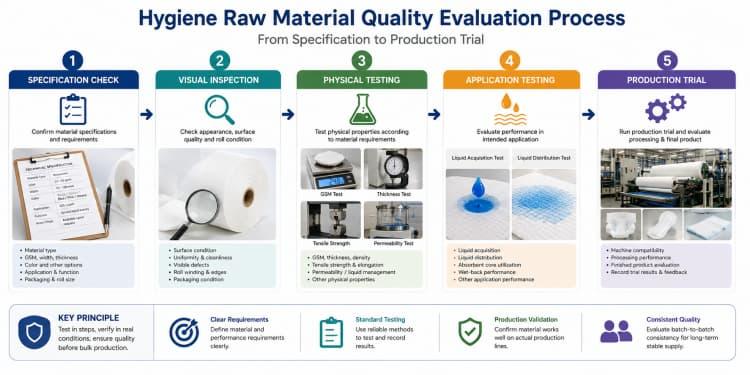
The exact tests depend on the type of raw material.
Possible evaluations may include:
· Tensile strength
· Elongation
· Thickness
· GSM
· Permeability
· Absorption or liquid-management performance
· Dimensional stability
Not every test applies to every material.
The testing program should therefore be based on the technical requirements of the specific material.
Laboratory measurements alone may not provide a complete picture.
The material should also be evaluated according to how it performs in its intended application.
For example, an ADL material may need to be evaluated for liquid acquisition and distribution.
An elastic material may need to be evaluated for elasticity and recovery.
A PE film may need to be evaluated according to the requirements of the final product structure.
A material may meet laboratory specifications but still perform differently during manufacturing.
Therefore, buyers should also consider:
· Feeding performance
· Cutting performance
· Lamination
· Adhesion
· Machine compatibility
· High-speed processing
The actual evaluation depends on the material and production process.
When possible, buyers can compare a new material with the material currently being used.
A comparison can help identify differences in:
· Specifications
· Physical properties
· Processing behavior
· Finished product performance
· Production efficiency
This can make the evaluation more practical for manufacturers.
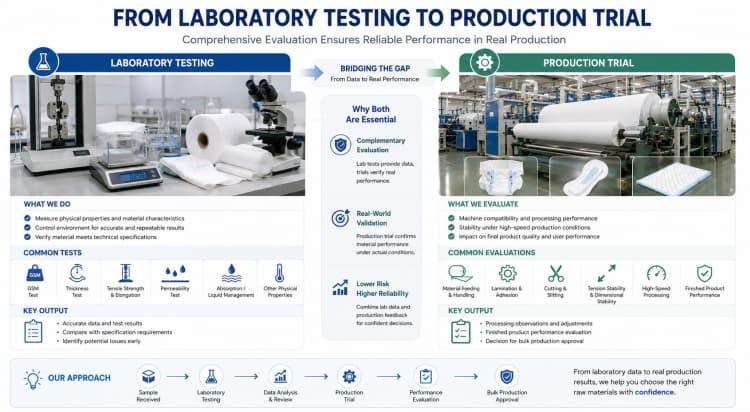
Laboratory testing provides useful technical information, but it may not fully represent actual production conditions.
A production trial allows manufacturers to see how the material behaves on the real production line.
This is especially important for materials used in high-speed converting processes.
During a production trial, manufacturers can observe whether the material runs smoothly through the equipment.
Potential issues may include:
· Feeding problems
· Material deviation
· Edge damage
· Tension problems
· Cutting difficulties
· Lamination problems
Early identification of these issues can reduce the risk of problems during bulk production.
The material should also be evaluated after it has been incorporated into the finished product.
Manufacturers can compare the trial product with the existing product or target specification.
This provides a more complete evaluation of the material.
Production trial results should be recorded.
Useful information may include:
· Material specification
· Machine conditions
· Production speed
· Trial quantity
· Processing observations
· Finished product results
· Problems identified
· Required adjustments
A documented trial makes future material evaluation easier and more consistent.
Passing one sample does not necessarily mean every future batch will have identical performance.
Manufacturers should monitor important specifications between batches.
Depending on the material, these may include:
· GSM
· Width
· Thickness
· Color
· Physical properties
· Roll dimensions
Appearance should also remain reasonably consistent with the agreed product requirements.
Significant changes in color, surface condition, roll appearance, or other visible characteristics may require investigation.
The most important question is often whether the material continues to perform consistently on the production line.
A material that performs well in one batch but creates processing problems in another can increase production risk.
Maintaining quality records can help buyers identify changes over time.
A basic record can include:
· Batch number
· Production date
· Specification
· Inspection results
· Test results
· Production trial results
· Quality issues
These records provide a useful reference when evaluating future deliveries.
Variation in GSM, width, thickness, or other agreed specifications may affect production performance.
The acceptable tolerance should be clearly defined before bulk production.
Visible defects may include:
· Contamination
· Uneven surface
· Damaged edges
· Holes
· Wrinkles
· Irregular winding
The specific defect criteria depend on the material.
A material may appear acceptable during inspection but create problems during production.
Examples include:
· Difficult feeding
· Poor cutting
· Unstable tension
· Lamination problems
· Excessive material deviation
This is why production trials are an important part of material qualification.
One of the most important risks is variation between different production batches.
If the same material behaves differently from batch to batch, manufacturers may need to adjust production conditions repeatedly.
Consistent manufacturing and quality control are therefore important considerations when evaluating a long-term raw material source.
Before testing a new material, confirm:
· Intended application
· Material type
· Required GSM
· Required width
· Required thickness
· Color requirements
· Packaging requirements
· Target performance
· Production conditions
During evaluation, check:
· Appearance
· Dimensions
· Physical properties
· Application performance
· Processing performance
· Compatibility with other materials
Record the results rather than relying only on visual impressions.
Before approving a material for bulk production, confirm:
· Sample meets agreed specifications
· Required performance has been verified
· Production trial has been completed
· Machine compatibility has been confirmed
· Finished product performance is acceptable
· Packaging requirements are confirmed
· Quality requirements are clearly communicated
Quality evaluation should continue after the first bulk order.
Manufacturers should monitor incoming batches and compare them with the approved sample or agreed specifications.
This creates a continuous quality-control process rather than a one-time inspection.
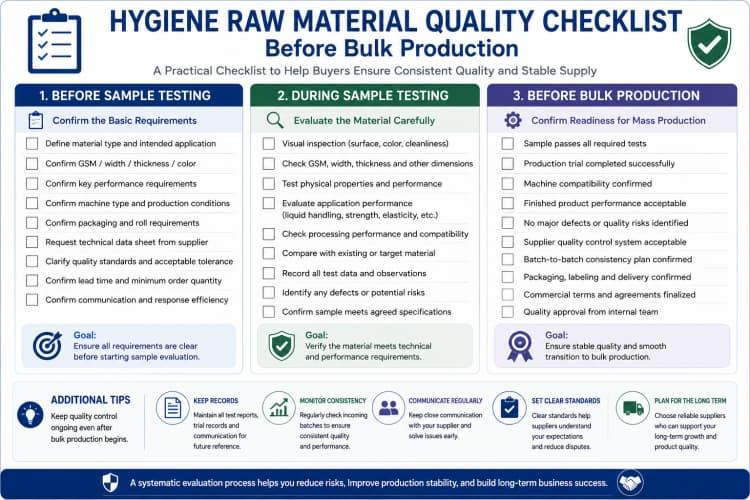
A hygiene raw material should not be judged by appearance or price alone.
Technical specifications, physical properties, application performance, and production behavior all need to be considered.
A structured evaluation process can help manufacturers reduce risks before placing a large order.
The basic process can be summarized as:
Specification Check → Sample Inspection → Performance Testing → Production Trial → Quality Evaluation → Bulk Production
The suitability of a raw material depends on where and how it will be used.
For disposable hygiene products, materials need to work together as part of a complete product structure.
Therefore, application testing and production trials are important steps before final approval.
Successful raw material qualification does not end when the first sample passes.
Long-term batch consistency, production performance, and quality records should also be monitored.
A systematic approach to raw material evaluation can help disposable hygiene manufacturers improve production stability, reduce quality risks, and make more confident purchasing decisions.

 MP/WhatsApp: +86-18050806553
 Manufacturer Address:Juhua Industry Matou Town, Nanan City Fujian Province China