

Hot Keyword:
Author:Baby & Adult Diaper Materials FROM:Diaper Materials Manufacturer TIME:2026-08-21
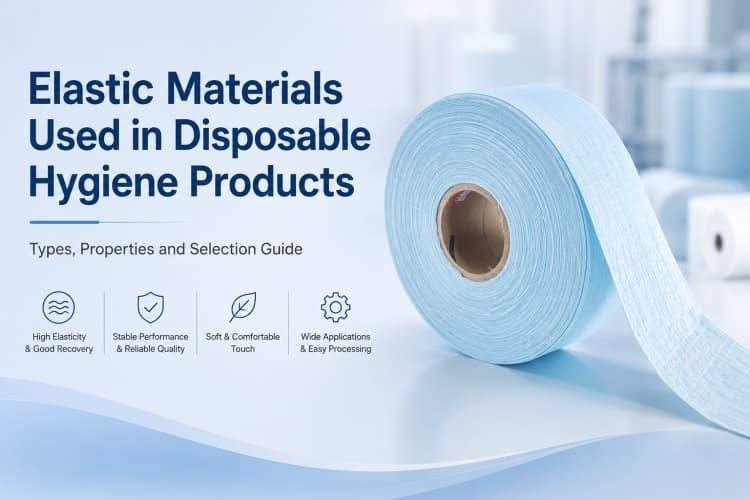
Elastic materials are important functional raw materials used in disposable hygiene products.
They help provide stretch, flexibility, recovery, and a better fit in different areas of hygiene products. The material used for a waistband does not necessarily have the same requirements as the material used for elastic ear areas.
For this reason, hygiene product manufacturers need to select elastic materials according to their specific application, construction, required elasticity, and production process.
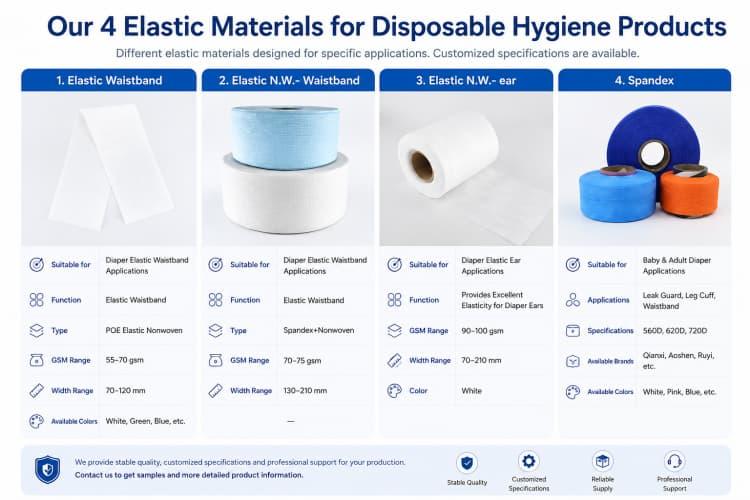
Our elastic material range focuses on four main products:
· Elastic Waistband
· Elastic Nonwoven for Waistband
· Elastic Nonwoven for Ears
· Spandex
This guide explains the characteristics and applications of these four materials and provides practical considerations for buyers when selecting an elastic material supplier.
Elastic materials are functional raw materials designed to provide controlled stretch and recovery within disposable hygiene products.
Depending on the application, they may be used in waistband structures, ear areas, leak guards, leg areas, or other parts requiring elasticity.
The material needs to work together with other components such as nonwoven, adhesive, and other layers.
Elasticity allows a material to stretch when tension is applied and recover when the tension is released.
In hygiene manufacturing, suitable elasticity can help achieve:
· Flexible product structures
· Stable fit
· Controlled stretch
· Good recovery
· Reliable production performance
A waistband and an ear area do not necessarily require the same elastic material.
The required width, GSM, elasticity, recovery, and processing method may vary according to the application.
Therefore, material selection should always start with the actual application requirement.
Our elastic material range includes four main products for disposable hygiene applications.
Elastic waistband material is designed for waistband applications where controlled elasticity is required.
It can be supplied in different widths, GSM ranges, and colors according to customer requirements.
Elastic nonwoven waistband material combines a nonwoven structure with elastic properties.
It is designed for waistband applications and can provide a soft material structure together with elasticity.
Elastic nonwoven for ears is designed specifically for elastic ear applications.
Its material structure is suitable for areas where elasticity and flexibility are required.
Spandex is an elastic yarn material used in different disposable hygiene applications.
It can be used in areas such as:
· Leak guard
· Leg cuff
· Waistband
Different specifications, colors, and brands may be available depending on customer requirements.
Elastic Waistband is designed for disposable diaper waistband applications.
According to the product specifications, this material uses POE elastic nonwoven and is available in different GSM and width ranges.
Typical specifications include:
· Function: Elastic waistband
· Type: POE Elastic Nonwoven
· GSM Range: 55–70 gsm
· Width Range: 70–120 mm
· Available Colors: White, green, blue, and others
Specifications can be selected according to the customer's production requirements.
The primary application is the elastic waistband area of disposable diapers.
The material needs to provide suitable elasticity while maintaining stable performance during converting and assembly.
When purchasing elastic waistband material, buyers should consider:
· Required width
· GSM
· Elasticity
· Recovery
· Material softness
· Color
· Production compatibility
Elastic Nonwoven for Waistband is another material designed for disposable diaper waistband applications.
Compared with conventional elastic components, an elastic nonwoven structure provides a wider material format that can be incorporated into waistband constructions.
Typical specifications include:
· Function: Elastic waistband
· Type: POE Elastic Nonwoven
· GSM Range: 55–70 gsm
· Width Range: 70–120 mm
· Available Colors: White, green, blue, and others
The primary application is the waistband area of disposable diapers.
The material can be selected according to the required width, GSM, elasticity, and production process.
Buyers should evaluate:
· GSM consistency
· Width accuracy
· Elastic performance
· Recovery
· Softness
· Roll quality
· Processing stability
For high-volume production, consistency between different batches is particularly important.
Elastic Nonwoven for Ears is designed for elastic ear applications in disposable diapers.
The material provides elasticity in the ear area while maintaining a nonwoven structure.
Typical specifications include:
· Function: Provides elasticity for diaper ears
· GSM Range: 90–100 gsm
· Width Range: 70–210 mm
· Color: White
The final specification can be selected according to the customer's product construction.
The primary application is the elastic ear area of disposable diapers.
Because the ear area requires both flexibility and mechanical performance, material selection should consider elasticity, recovery, strength, and compatibility with the surrounding materials.
Important factors include:
· GSM
· Width
· Elasticity
· Recovery
· Tensile strength
· Softness
· Compatibility with the production process
Spandex is an elastic yarn material widely used in different disposable hygiene applications.
It can be supplied in different specifications and colors according to customer requirements.
Spandex can be used in applications including:
· Leak guard
· Leg cuff
· Waistband
The appropriate specification depends on the required elastic performance and production process.
Available specifications may include:
· 560D
· 620D
· 720D
Different brands may also be available depending on customer requirements.
Common options include:
· White
· Pink
· Blue
· Other colors according to requirements
When selecting spandex, buyers should consider:
· Denier
· Elasticity
· Recovery
· Tensile performance
· Application area
· Color
· Compatibility with the production process
The correct specification should be selected according to the required elastic performance rather than denier alone.
Different elastic materials have different technical requirements, but several properties are commonly important.
Elasticity determines how effectively the material can stretch under tension.
The required elasticity depends on the application.
Recovery describes the material's ability to return toward its original dimensions after stretching.
Good recovery can help maintain stable elastic performance.
Tensile strength is important for preventing material breakage during production and use.
The required strength depends on the application and material construction.
For elastic nonwoven materials, GSM and thickness are important specifications.
Changes in GSM can affect material weight, structure, handling, and overall performance.
Width accuracy is particularly important for roll materials used in automated production.
Consistent dimensions can help reduce production variation.
Softness can be an important consideration for materials incorporated into hygiene product structures.
The material should provide the required elasticity without compromising the desired material feel.
The correct material should be selected according to the actual application.

First determine where the material will be used.
For example:
· Waistband
· Ear area
· Leak guard
· Leg cuff
Different applications may require different elastic materials.
Determine the required:
· GSM
· Width
· Denier
· Elasticity
· Recovery
· Color
· Roll dimensions
Clear specifications help suppliers provide the correct material.
The material needs to work with the customer's existing production process.
Consider:
· Production speed
· Adhesive system
· Lamination process
· Cutting
· Tension control
· Material feeding
Before placing a large order, buyers should test samples under actual production conditions.
Sample testing can evaluate:
· Elasticity
· Recovery
· Tensile strength
· Processing stability
· Compatibility with other materials
After testing, buyers should also evaluate the supplier's ability to provide consistent quality and stable delivery for future orders.
Choosing the right supplier is just as important as choosing the right material.
The supplier should maintain consistent specifications between batches.
Important quality factors include:
· GSM
· Width
· Elasticity
· Recovery
· Tensile strength
· Roll quality
For disposable hygiene manufacturers, material supply interruptions can affect the entire production schedule.
A supplier should therefore have sufficient production capacity and reliable delivery capability.
A professional supplier should be able to help customers select materials based on their application and production requirements.
Technical communication is especially important when customers need customized specifications.
Different manufacturers may require different:
· Widths
· GSM
· Denier
· Colors
· Roll sizes
· Material specifications
Customization capability can help suppliers provide materials that fit specific production requirements.
A reliable supplier should be willing to provide samples for customer evaluation before bulk purchasing.
This allows buyers to verify actual performance before committing to a large order.
Elastic materials play an important role in disposable hygiene manufacturing.
Different applications require different material structures and specifications.
The four elastic material products covered in this guide are:
· Elastic Waistband
· Elastic Nonwoven for Waistband
· Elastic Nonwoven for Ears
· Spandex
When selecting an elastic material, buyers should consider the actual application, elasticity, recovery, tensile strength, GSM, width, denier, softness, processing compatibility, and supply stability.
The right material is not necessarily the one with the lowest price. It should provide the required performance while maintaining consistent quality and reliable production.
For long-term cooperation, buyers should also evaluate the supplier's quality control, production capacity, customization capability, technical support, and delivery reliability.
Choosing the right elastic material and supplier can help disposable hygiene manufacturers maintain stable production and build a more reliable raw material supply chain.

 MP/WhatsApp: +86-18050806553
 Manufacturer Address:Juhua Industry Matou Town, Nanan City Fujian Province China