

Hot Keyword:
Author:Baby & Adult Diaper Materials FROM:Diaper Materials Manufacturer TIME:2026-08-17
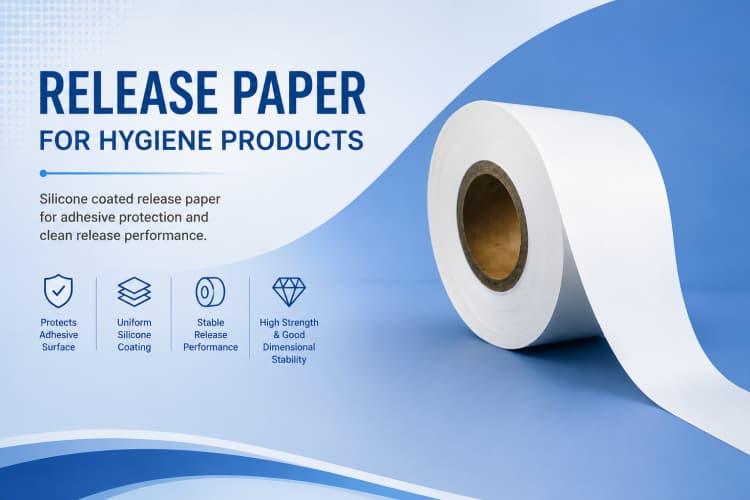
Release paper is an important functional raw material used in disposable hygiene manufacturing.
It is commonly used together with pressure-sensitive adhesives, helping protect adhesive surfaces before processing, storage, or final application.
For hygiene material buyers, release paper is more than just a protective backing. Its release force, silicone coating, paper strength, surface smoothness, and dimensional stability can all affect production efficiency and material performance.
Choosing the right release paper therefore requires a clear understanding of both the material structure and the requirements of the application.
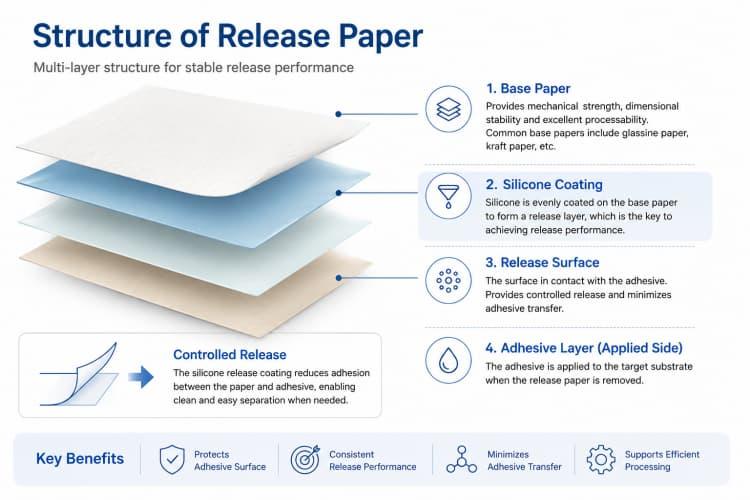
Release paper is a paper-based material coated with a release layer, commonly silicone.
The release coating creates a low-adhesion surface that allows adhesive materials to be separated from the paper when needed.
A typical release paper consists of three main components:
The base paper provides the structural foundation of the release paper.
Important characteristics include:
· Basis weight
· Thickness
· Tensile strength
· Surface smoothness
· Dimensional stability
A stable base paper helps maintain consistent performance during converting and transportation.
The silicone coating is one of the most important functional components.
It determines the release characteristics of the material and helps control the interaction between the release paper and adhesive.
Important coating factors include:
· Coating uniformity
· Silicone coverage
· Curing quality
· Release performance
Poor coating uniformity can lead to inconsistent release behavior during production.
The release surface is the final functional interface between the paper and adhesive.
Its performance needs to remain stable throughout:
· Processing
· Storage
· Transportation
· Application
The main function of release paper is to protect an adhesive surface while allowing controlled separation when required.
The basic working principle can be represented as:
Release Paper
↓
Silicone Release Coating
↓
Adhesive Layer
↓
Controlled Release
The silicone coating reduces the adhesion between the paper and the adhesive.
When the release paper is removed, the adhesive should remain on the intended material rather than transferring excessively to the release paper.
A suitable release paper should provide:
· Stable release performance
· Clean separation
· Minimal adhesive transfer
· Consistent coating performance
The performance of release paper depends not only on the paper itself but also on the coating and surface characteristics.
The base paper needs to provide sufficient strength and dimensional stability for converting and handling.
Important factors include:
· Basis weight
· Thickness
· Tensile strength
· Moisture resistance
· Dimensional stability
The silicone layer controls the release behavior and protects the adhesive surface.
The quality of the silicone coating can directly affect release consistency.
Important factors include:
· Coating uniformity
· Coating weight
· Curing condition
· Release force
Surface smoothness and coating uniformity can influence release consistency and processing performance.
For this reason, buyers should evaluate the complete material structure rather than focusing only on paper thickness or price.
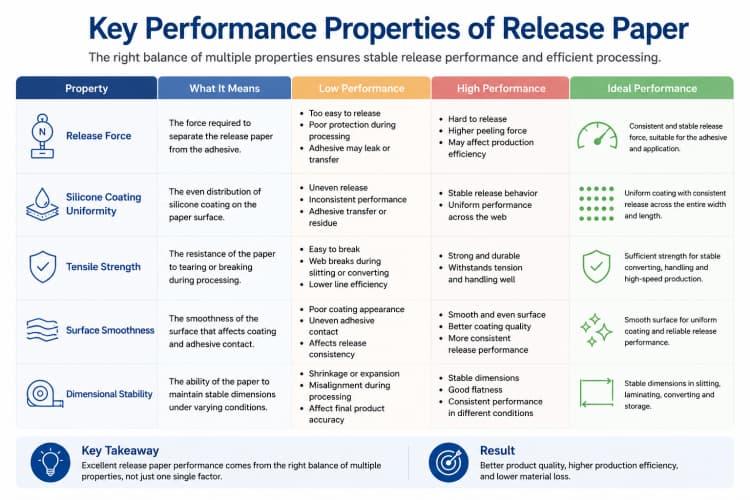
When purchasing release paper, buyers should evaluate several technical parameters.
Release force describes how much force is required to separate the release paper from the adhesive.
If the release force is too high, separation may become difficult.
If it is too low, the material may not provide sufficient protection during processing or storage.
The appropriate release force depends on the adhesive system and application requirements.
A uniform silicone coating helps provide consistent release performance across the material.
Uneven coating may result in:
· Inconsistent release
· Adhesive transfer
· Processing problems
Release paper needs sufficient tensile strength for converting and handling.
Higher mechanical stability can help reduce:
· Web breaks
· Material damage
· Production interruptions
A smooth surface can contribute to more consistent coating and processing performance.
Surface characteristics should be evaluated according to the intended application.
The paper should maintain stable dimensions during:
· Coating
· Slitting
· Converting
· Transportation
Good dimensional stability helps improve production consistency.
Different applications may require different release paper constructions.
One side of the paper is coated with a release layer.
This structure is suitable when release performance is required on only one surface.
Both sides are coated with release material.
It can be used when controlled release is required from both surfaces.
Glassine is a smooth, dense paper substrate that can provide good surface properties and dimensional stability.
It is commonly considered when a thin and smooth release material is required.
Kraft-based release paper can provide good mechanical strength and handling performance.
The appropriate type depends on the application, adhesive system, and required release characteristics.
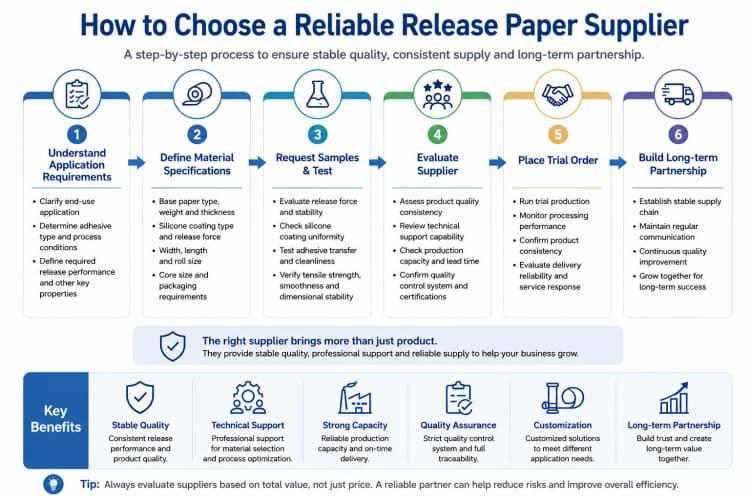
The correct release paper should be selected according to the actual application rather than price alone.
Different adhesives may require different release characteristics.
Before selecting a material, buyers should confirm:
· Adhesive type
· Adhesive viscosity
· Required release force
· Processing temperature
Important specifications may include:
· Width
· Thickness
· Basis weight
· Release force
· Coating type
· Roll dimensions
Clear specifications help suppliers provide more accurate material recommendations.
Consider how the release paper will be:
· Coated
· Laminated
· Slit
· Die-cut
· Stored
The material should be compatible with the customer's production process.
Sample testing is an important step before placing a large order.
Testing can evaluate:
· Release performance
· Adhesive transfer
· Surface quality
· Tensile strength
· Processing stability
A reliable release paper supplier should provide more than competitive pricing.
The supplier should maintain stable:
· Base paper quality
· Silicone coating
· Release force
· Thickness
Consistent quality is particularly important for manufacturers running continuous production.
A professional supplier should be able to discuss material specifications and recommend suitable release solutions based on the customer's application.
Technical support can help buyers avoid selecting materials based only on price.
For long-term cooperation, buyers should evaluate whether the supplier can maintain stable production capacity and delivery schedules.
A supplier with stable production capacity can reduce the risk of material shortages and unexpected production interruptions.
Important quality-control areas include:
· Raw material inspection
· Coating control
· Release force testing
· Thickness inspection
· Finished roll inspection
Different customers may require different:
· Widths
· Thicknesses
· Release forces
· Roll sizes
· Surface specifications
A supplier with customization capability can provide a more suitable material solution.
Release paper is an important functional raw material for applications involving pressure-sensitive adhesives.
Its performance depends on several factors, including:
· Base paper quality
· Silicone coating
· Release force
· Surface smoothness
· Tensile strength
· Dimensional stability
For buyers, selecting the right release paper means finding the right balance between release performance, processing requirements, quality consistency, and cost.
A reliable release paper supplier should provide stable quality, technical support, customization capability, and dependable supply.
By evaluating both material specifications and supplier capabilities, hygiene manufacturers can reduce production risks and establish a more stable raw material supply chain.

 MP/WhatsApp: +86-18050806553
 Manufacturer Address:Juhua Industry Matou Town, Nanan City Fujian Province China