

Hot Keyword:
Author:Baby & Adult Diaper Materials FROM:Diaper Materials Manufacturer TIME:2026-06-26
Consumer expectations for sanitary napkins have changed significantly over the past decade. Today's users expect products that are thinner, more comfortable, and highly absorbent while maintaining dryness throughout use.
To meet these requirements, manufacturers increasingly rely on Super Absorbent Polymer (SAP) as a key absorbent material.
SAP plays a critical role in modern sanitary napkin construction by helping absorb, distribute, and retain liquid efficiently.
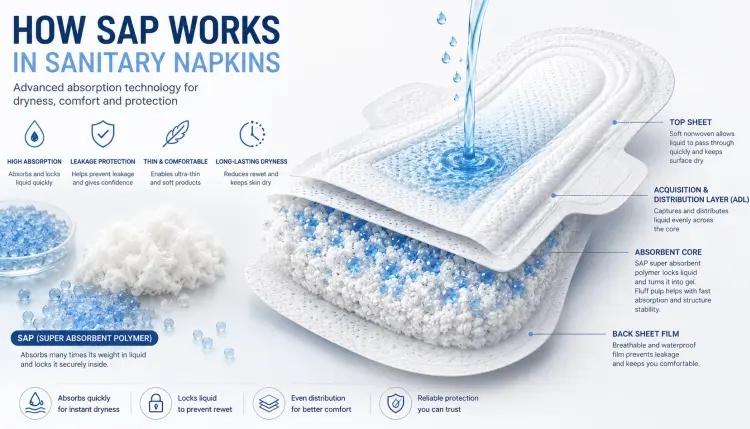
Super Absorbent Polymer (SAP) is a highly absorbent material capable of absorbing many times its own weight in liquid.
When fluid comes into contact with SAP particles, they rapidly absorb moisture and form a gel-like structure that locks liquid inside.
This technology is widely used in:
· Sanitary napkins
· Panty liners
· Baby diapers
· Adult incontinence products
SAP has become one of the most important materials in disposable hygiene products.
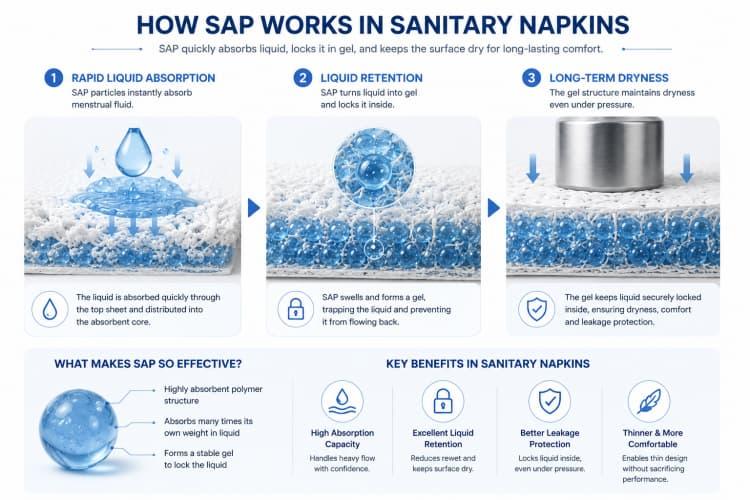
SAP works by capturing liquid and converting it into a stable gel.
The process typically follows three stages:
As menstrual fluid enters the absorbent core, SAP particles quickly absorb moisture.
After absorption, SAP transforms liquid into gel, preventing it from flowing back to the surface.
The gel structure helps keep liquid locked inside even under pressure, improving comfort and reducing leakage risks.
This mechanism allows sanitary napkins to remain dry and effective throughout use.
SAP can absorb significantly more liquid than traditional absorbent materials.
Benefits include:
· Higher absorbency
· Longer wear time
· Reduced leakage
One of SAP's biggest advantages is its ability to reduce rewet.
This helps:
· Keep the surface drier
· Improve comfort
· Reduce skin irritation
Because SAP locks liquid inside the absorbent core, it helps prevent leakage during movement and extended wear.
This is especially important for:
· Overnight pads
· Heavy-flow products
· Premium sanitary napkins
SAP allows manufacturers to reduce the amount of fluff pulp required.
As a result, products can be:
· Thinner
· Lighter
· More comfortable
This trend has become increasingly important in European and North American markets.
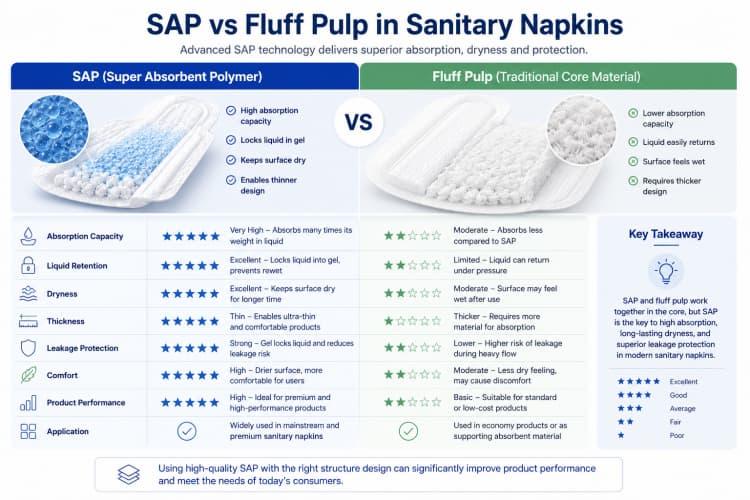
Before SAP became widely used, sanitary napkins relied mainly on fluff pulp.
|
Feature |
SAP |
Fluff Pulp |
|
Absorption Capacity |
High |
Moderate |
|
Liquid Retention |
Excellent |
Limited |
|
Dryness |
Excellent |
Moderate |
|
Product Thickness |
Thin |
Thicker |
|
Leakage Protection |
Strong |
Lower |
Today, most modern sanitary napkins use a combination of SAP and fluff pulp to achieve balanced performance.
Choosing the right SAP depends on several factors:
The SAP should match the intended product category.
Higher gel strength improves liquid retention under pressure.
Lower rewet values improve user comfort.
Manufacturers must balance performance and production cost.
Consistent quality and reliable delivery are critical for large-scale production.
A sanitary napkin manufacturer supplying private-label products in Europe wanted to improve overnight product performance.
After upgrading to a higher-performance SAP:
· Absorption efficiency improved
· Rewet values decreased
· Product thickness was reduced
· Customer satisfaction increased
The improvement allowed the brand to position its product as a premium offering while maintaining competitive production costs.
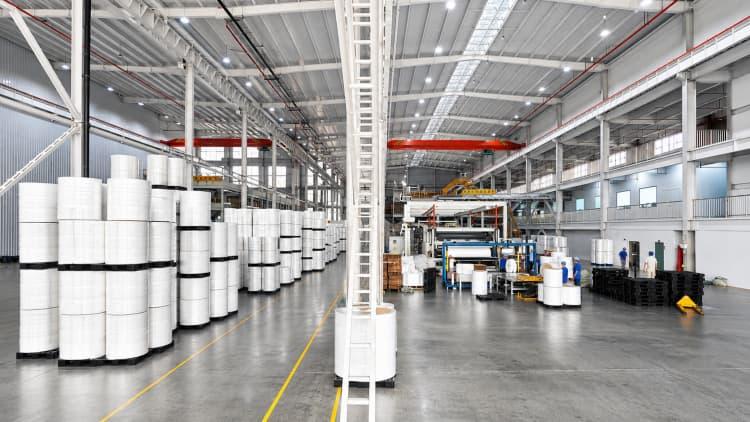
SAP has transformed the sanitary napkin industry by enabling higher absorption, better dryness, and thinner product designs.
For manufacturers and brands, selecting the right SAP is essential for producing competitive products that meet modern consumer expectations.
As demand for comfort and performance continues to grow, SAP will remain a key component in advanced feminine hygiene products.

 MP/WhatsApp: +86-18050806553
 Manufacturer Address:Juhua Industry Matou Town, Nanan City Fujian Province China