

Hot Keyword:
Author:Baby & Adult Diaper Materials FROM:Diaper Materials Manufacturer TIME:2026-04-29
In diaper manufacturing, raw materials account for a significant portion of total production cost. For diaper brands, OEM factories, and importers, understanding material cost is essential for maintaining profitability while delivering consistent product quality.
However, reducing cost is not simply about buying cheaper materials. Low-cost materials can lead to poor absorption performance, leakage issues, inconsistent quality, and customer complaints—all of which create higher long-term costs.
The smarter approach is cost optimization, where manufacturers balance price, performance, and supply stability.
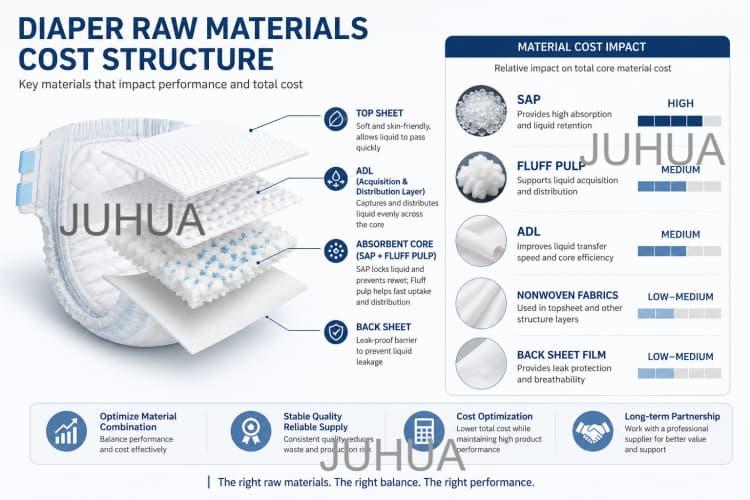
Among all diaper materials, Super Absorbent Polymer (SAP), fluff pulp, and Acquisition & Distribution Layer (ADL) are three of the most influential cost components in the absorbent core system.
While diapers include multiple materials such as nonwoven fabrics, back sheet film, elastic components, and adhesives, the absorbent core usually represents the largest material investment.
The three core cost drivers are:
· SAP – determines absorption capacity and dryness
· Fluff pulp – supports liquid acquisition and distribution
· ADL – improves liquid transfer efficiency
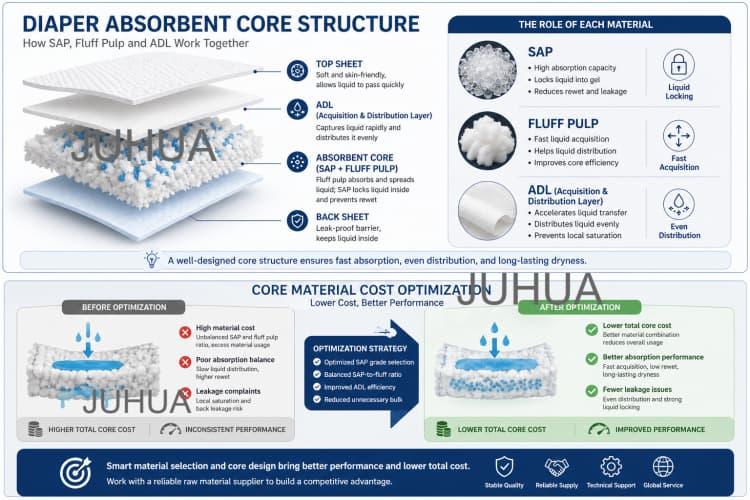
How these materials are selected and combined has a direct impact on both cost and product performance.
SAP is often one of the highest-value materials in diaper manufacturing.
Several factors influence SAP pricing.
2.1 Absorption PerformanceHigher-performance SAP generally costs more because it offers:
· Better absorption capacity
· Faster liquid uptake
· Lower rewet performance
· Stronger gel retention under pressure
Premium diapers typically use higher-grade SAP.
Not all SAP products perform consistently across batches.
Buyers often pay more for suppliers that provide:
· Stable performance specifications
· Consistent particle size distribution
· Reliable long-term supply
For manufacturers, stability often creates more value than chasing the lowest unit price.
Bulk purchasing usually improves pricing efficiency.
Long-term partnerships with reliable suppliers can also reduce:
· Logistics cost
· Supply disruption risk
· Production planning uncertainty
This creates a healthier overall cost structure.
Fluff pulp pricing is influenced by:
· Wood pulp source quality
· Fiber consistency
· Absorption speed
· Global pulp market fluctuations
· Shipping and storage costs
High-quality fluff pulp improves liquid distribution and supports efficient SAP usage, which can lower overall core material consumption.
ADL is a smaller cost component than SAP or fluff pulp, but its performance impact can be significant.
ADL cost depends on:
· Material type (hot air through / high-loft / bonded nonwoven)
· Thickness and density
· Liquid distribution efficiency
· Structural durability
A better ADL can improve core efficiency, allowing manufacturers to optimize SAP usage.
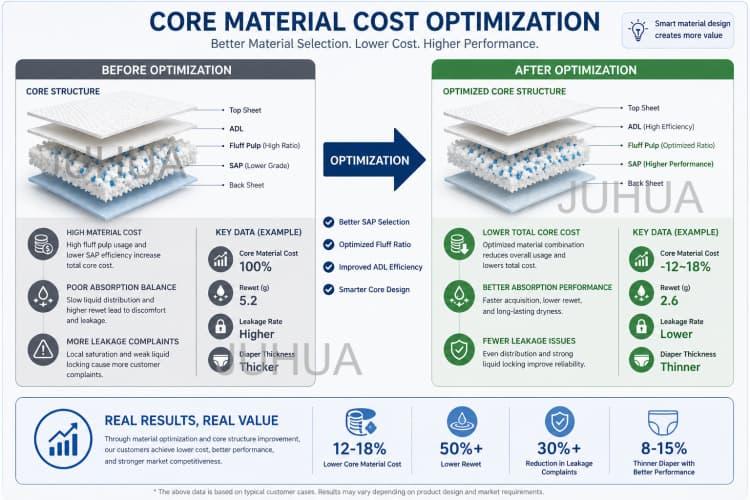
Successful diaper manufacturers focus on material system optimization, not individual material price.
Common strategies include:
· Optimizing SAP-to-fluff pulp ratio
· Improving ADL efficiency
· Reducing unnecessary core bulk
· Working with stable direct manufacturers
· Testing different material combinations
This often leads to lower total product cost with better product performance.
A diaper manufacturer supplying Southeast Asia wanted to reduce product cost while maintaining quality.
Instead of simply buying lower-cost SAP, they optimized:
· SAP grade selection
· Fluff pulp ratio
· ADL structure
Results:
· Reduced total core material cost
· Improved liquid distribution
· Lower rewet rate
· Better customer feedback
This demonstrates that smart material selection is the key to cost efficiency.
The true cost of diaper raw materials is not defined by price alone—it is defined by price + performance + consistency + supply reliability.
For manufacturers and importers, choosing the right combination of SAP, fluff pulp, and ADL is the most effective way to improve profitability while maintaining product quality.
Working with experienced material suppliers can help create a more stable and competitive cost structure for long-term growth.

 MP/WhatsApp: +86-18050806553
 Manufacturer Address:Juhua Industry Matou Town, Nanan City Fujian Province China