

Hot Keyword:
Author:Baby & Adult Diaper Materials FROM:Diaper Materials Manufacturer TIME:2026-03-27
In the global diaper industry, absorption performance is one of the most important factors influencing product quality and consumer satisfaction. Parents expect diapers to keep babies dry, prevent leakage, and protect delicate skin during long hours of wear.
For diaper manufacturers and private-label brands, achieving these goals depends largely on the design of the absorbent core. Modern diapers are not simply made from cotton-like materials. Instead, they use a carefully engineered combination of advanced absorbent materials and structural layers.
Understanding how diapers absorb liquid helps manufacturers optimize product performance, reduce leakage risks, and improve comfort for end users.
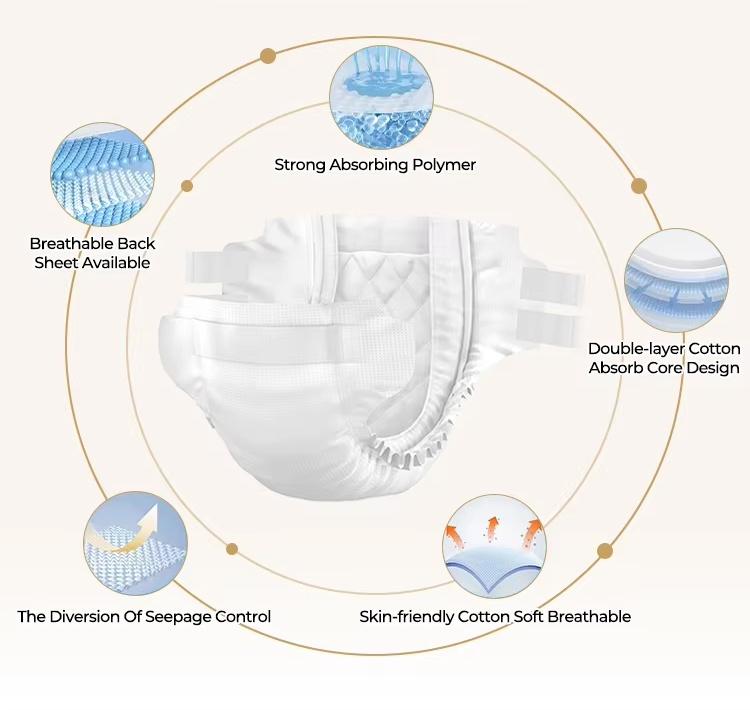
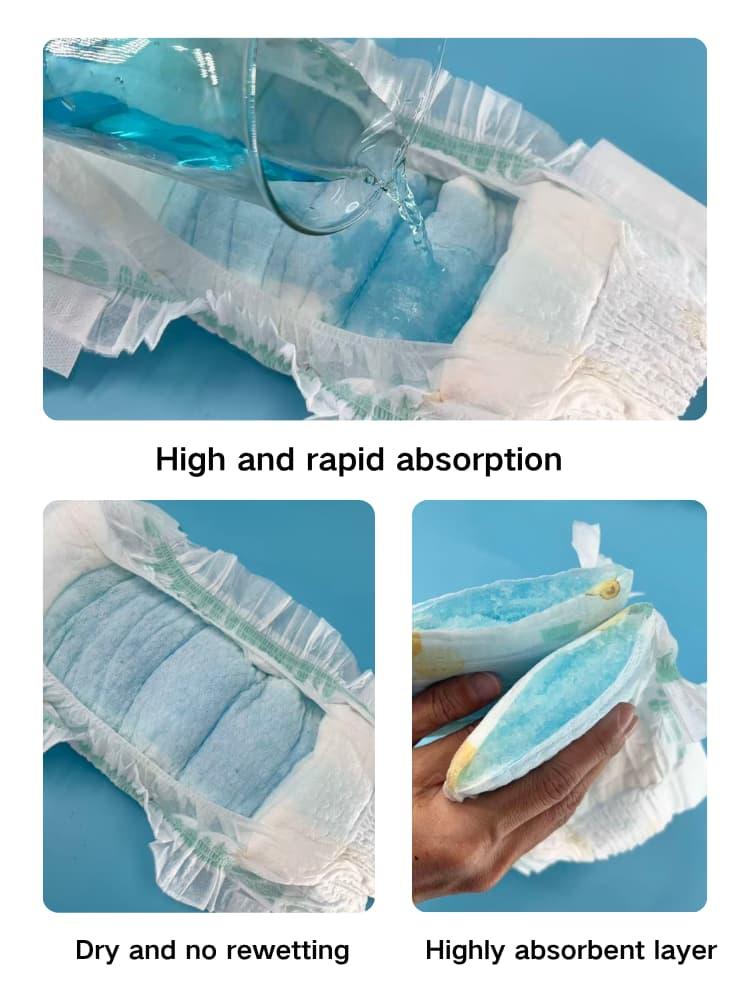
A diaper absorbs liquid through a multi-layer absorption system designed to capture, distribute, and retain moisture efficiently.
When liquid enters the diaper, several steps occur almost instantly:
Step 1: Liquid penetration through the top sheet
The liquid first passes through the surface layer, which is designed to allow fast penetration while keeping the surface dry.
Step 2: Rapid absorption and distribution
The liquid is quickly absorbed and spread by the distribution layer and fluff pulp to prevent localized saturation.
Step 3: Liquid retention inside the core
Super Absorbent Polymer (SAP) particles absorb and lock the liquid inside the absorbent core, preventing it from returning to the surface.
This multi-step process ensures that diapers remain dry, comfortable, and leak-resistant.

Several specialized materials work together to form the diaper’s absorbent core. Each material plays a different role in fluid management.
Super Absorbent Polymer is the most critical material in modern diapers. SAP can absorb and retain liquid hundreds of times its own weight, forming a gel that locks moisture inside the core.
Key benefits of SAP include:
High absorption capacity
Strong liquid retention
Reduced rewet rate
Long-lasting dryness
Because of these advantages, SAP is widely used in baby diapers, adult diapers, and other hygiene products.
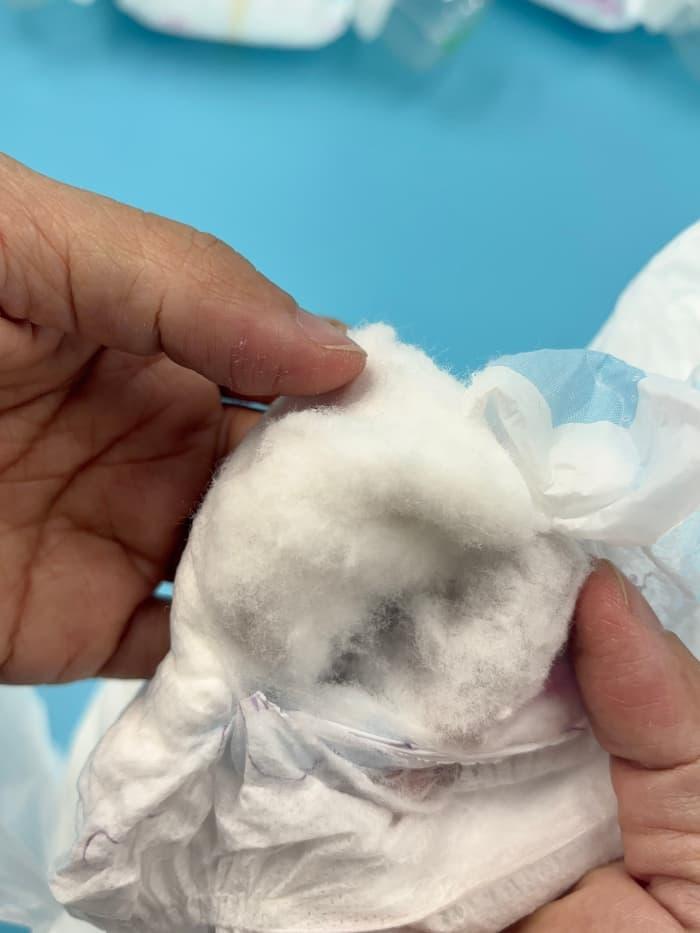
Fluff pulp is typically made from virgin wood pulp fibers and acts as a supporting material in the absorbent core.
Its main functions include:
Quickly absorbing liquid when it first enters the diaper
Distributing liquid evenly across the core
Providing structure and stability for the absorbent core
Without fluff pulp, liquid may concentrate in one area, reducing the overall efficiency of the absorption system.
The Acquisition and Distribution Layer (ADL) is an additional layer designed to improve liquid flow within the diaper core.
Its functions include:
Rapidly capturing liquid from the surface
Distributing liquid across the absorbent core
Preventing localized leakage
ADL is commonly used in premium diapers and high-performance products where dryness and leakage protection are critical.
As consumer expectations increase, diaper manufacturers continue to improve absorbent core technology.
Modern diapers often use higher SAP concentrations to increase absorption capacity while reducing overall diaper thickness.
This design provides several advantages:
Higher liquid retention
Longer wearing time
Reduced diaper bulk
High-SAP cores are especially common in premium diaper brands.
Consumers increasingly prefer thin, lightweight diapers that still provide excellent absorption.
Manufacturers achieve this by:
Increasing SAP efficiency
Optimizing fluff pulp distribution
Improving core structural design
Ultra-thin diaper technology allows products to remain comfortable while maintaining strong absorption performance.
A diaper manufacturer supplying private-label products to European retailers wanted to improve the overnight performance of its diapers without increasing thickness.
The engineering team optimized the absorbent core by:
Increasing SAP concentration
Improving fluff pulp distribution
Adding a more efficient ADL layer
After the redesign, the diaper achieved:
Higher absorption capacity
Lower rewet rate
Better overnight leakage protection
Thinner and more comfortable structure
This example demonstrates how proper absorbent core design can significantly improve diaper performance.
Modern diapers rely on a sophisticated absorbent core system that combines SAP, fluff pulp, and advanced distribution layers to manage liquid efficiently.
As diaper technology continues to evolve, manufacturers are focusing on:
Higher SAP efficiency
Thinner absorbent cores
Improved liquid distribution
More sustainable materials
For diaper brands and manufacturers, understanding how these materials work together is essential for developing products that meet modern consumer expectations for dryness, comfort, and reliability.

 MP/WhatsApp: +86-18050806553
 Manufacturer Address:Juhua Industry Matou Town, Nanan City Fujian Province China